

Table of Contents
You’re Not Imagining It: The Science Behind Feeling Invisible After 50
Have you ever stood in a crowded room and felt like you were wearing an invisibility cloak? Or tried to speak up in a meeting, only to have your voice seemingly absorbed by the walls? If you’re a woman over 50, this experience is likely all too familiar. You’re not imagining it, and you’re certainly not alone.
This phenomenon, often called “Invisible Woman Syndrome,” is a recognized psychological experience that researchers have formally termed “Age-related Gendered Diminishment” (AGD) [1]. It’s the pervasive feeling of being overlooked, unheard, and inconsequential in a world that often equates a woman’s value with her youth and reproductive capacity.
For many of us, the sense of feeling invisible after 50 creeps in slowly. It might start with a dismissive glance from a younger colleague, being ignored by a barista, or realizing that you’re no longer the target demographic for most advertising.
A staggering 70% of women over 50 report feeling overlooked socially and professionally. Additionally, 41% of menopausal women admit to feeling “lonely, invisible, irrelevant and dispensable [2, 3]. This isn’t just a feeling; it’s a cultural and social reality that has profound consequences for our mental and physical health.
The constant experience of being dismissed can lead to a state where women feel invisible after 50 — which is more than just a social slight. It’s a form of chronic emotional invalidation.
This feeling of disappearing has deep roots. It’s a toxic cocktail of ageism and sexism — a “double standard of aging” where men are often seen as gaining status and authority with age, while women are devalued [4].
This societal bias is compounded by biological changes. As we enter menopause, declining estrogen levels can impact our “social brain,” affecting neurotransmitters like oxytocin — the bonding hormone. This can make us feel less connected and more withdrawn [5].
It’s a perfect storm that can leave you feeling lonely and invisible, questioning your place in the world. But this is not the end of your story. It’s a transition, and with the right strategies, you can learn to reclaim your spark and step back into your power.
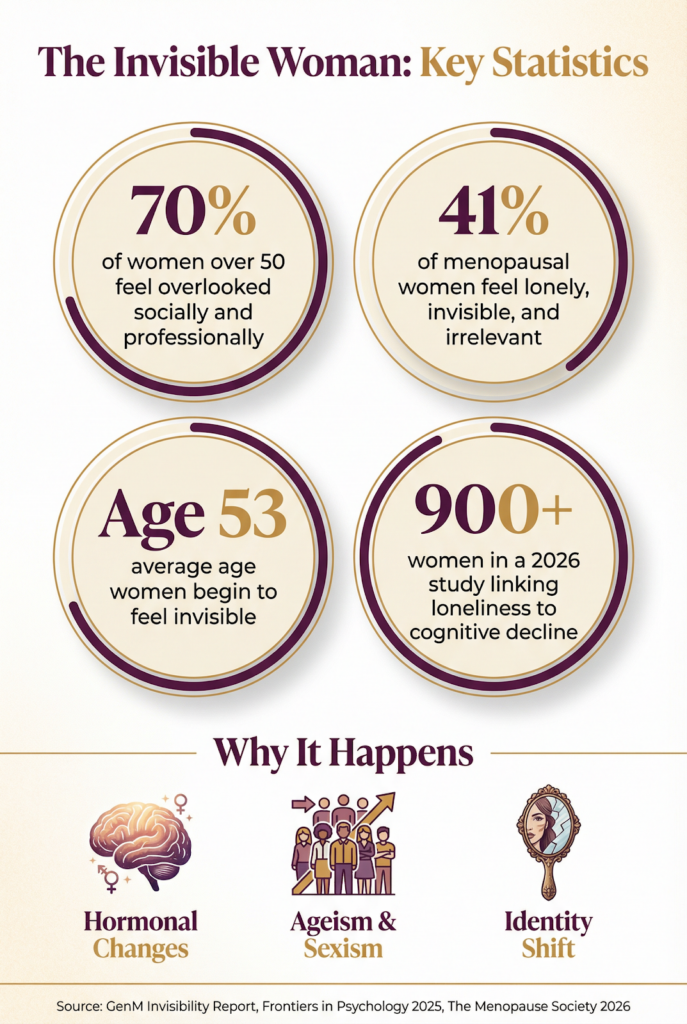
Infographic 1 | Alt text: ‘The Invisible Woman: Key Statistics’ infographic showing that 70% of women over 50 feel overlooked, 41% feel lonely and invisible, the average age women begin feeling invisible is 53, and a 2026 study of 900+ women linked loneliness to cognitive decline. Three root causes are shown: Hormonal Changes, Ageism & Sexism, and Identity Shift.
Try Our New Tool
Why Do Women Feel Invisible After 50? The Unseen Forces at Play
The feeling of invisibility isn’t a personal failing; it’s a systemic issue woven into the fabric of our society and amplified by the biological shifts of menopause. Understanding these forces is the first step toward dismantling them.
Researchers have identified a complex interplay of factors that contribute to why women feel invisible after 50. It’s a combination of being overlooked in social and professional settings, a lack of representation in media, and the pervasive cultural narrative that a woman’s worth diminishes as she ages [1].
One of the most significant factors is the societal shift in how we are perceived. As we move beyond our reproductive years, we often find ourselves untethered from the roles that once defined us — mother, caregiver, and even the object of the “male gaze.” While for some this can be liberating, for many it leads to a crisis of identity.
We are no longer seen for our potential, but are often reduced to stereotypes like the matronly grandmother figure, which can feel deeply invalidating [1]. This experience is so common that the average age women report starting to feel invisible is 53, though many feel it begin as early as 48 [2].
This social diminishment has a direct impact on our well-being. Studies have shown that feeling lonely and invisible is not just an emotional state; it has tangible health consequences.
Research from The Menopause Society has demonstrated a powerful link between loneliness, social isolation, and subjective cognitive decline in perimenopausal women [6]. When we feel disconnected and unseen, it can literally affect our brain health, impacting memory, attention, and processing speed. This is why it’s so critical to actively combat these feelings and seek out connection.
The Biological Undercurrent: Hormones and the Social Brain
It’s not just society that’s changing; our biology is too. The hormonal fluctuations of menopause, particularly the decline in estrogen, play a crucial role in how we experience the world socially.
Estrogen is a key regulator of the brain’s social circuitry, influencing the production and reception of oxytocin — often called the “love hormone” or “bonding hormone” [5]. When estrogen levels drop, so can our natural inclination toward social engagement, making us feel more withdrawn and isolated.
This biological shift can make it harder to maintain social connections at a time when we need them most, creating a vicious cycle of isolation and invisibility.
A landmark 2025 study published in Frontiers in Psychology identified this experience as “Age-related Gendered Diminishment” — a distinct psychological construct affecting women after midlife. The research found that the experience is driven by both social factors (ageism, sexism, lack of media representation) and biological predispositions, and that it remains significantly under-recognized in mental health contexts [1]. Knowing this has a name, and knowing it’s not your fault, is itself a form of liberation.
How to Reclaim Your Spark: 5 Proven Strategies to Be Seen and Heard
Feeling invisible is a heavy burden, but it’s one you don’t have to carry forever. It’s time to reclaim your spark and demand the space you deserve. This isn’t about trying to be the person you were at 30; it’s about stepping into the powerful, wise, and authentic woman you are now. It requires a conscious effort to shift your mindset, your habits, and the way you interact with the world. Here are five powerful strategies to help you move from feeling invisible to feeling invincible.
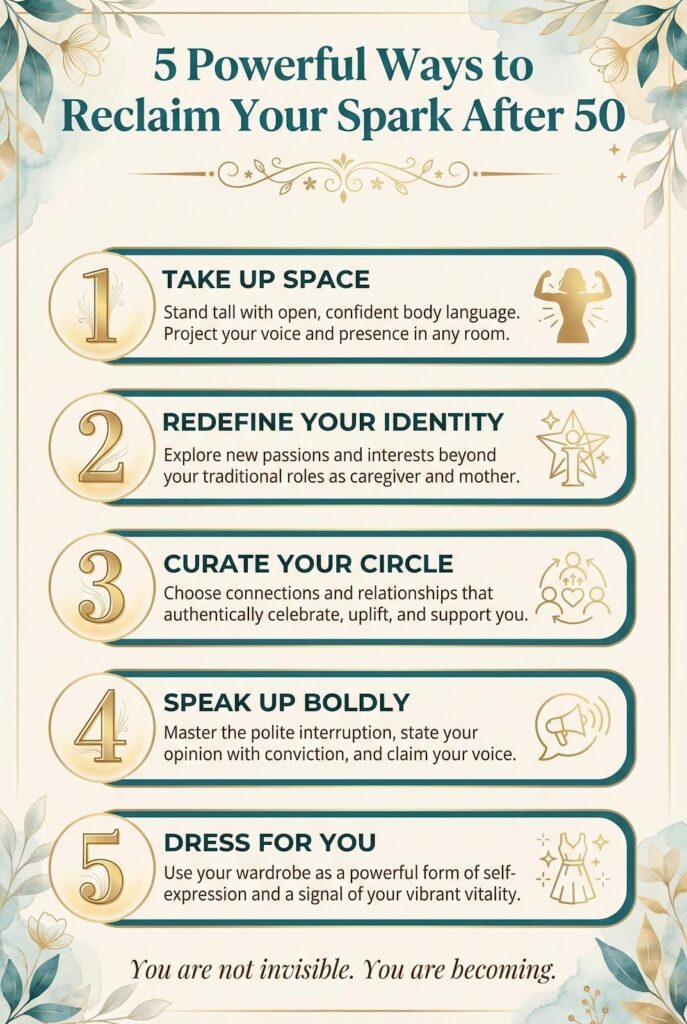
1. Take Up Space: The Physical Act of Reclaiming Your Presence
For years, many of us have been conditioned to make ourselves smaller, both literally and figuratively. We cross our legs, pull in our arms, and soften our voices to be less intrusive. It’s time to unlearn that behavior. To take up space is a physical act of defiance against invisibility. Stand tall with your shoulders back. When you sit, don’t shrink into the corner of the chair; claim your territory. Use open and expansive body language. When you speak, project your voice from your diaphragm, allowing it to carry weight and authority.
This isn’t about being aggressive; it’s about being present and unapologetic in your existence. Practice this in low-stakes situations, like ordering coffee or browsing in a store, and notice how it shifts the way people respond to you. Research on body language and confidence consistently shows that our physical posture doesn’t just communicate confidence to others — it actually generates it within ourselves [8]. You deserve to occupy your full space in every room you enter.
2. Redefine Your Identity Beyond Your Roles
So much of our identity as women is tied to our roles: mother, wife, daughter, employee. As those roles shift in midlife, it can feel like we’re losing ourselves. The key is to see this not as a loss, but as an opportunity for reinvention. Who are you outside of what you do for others? What are your passions, your interests, your curiosities? This is the time to explore them. Take that pottery class you’ve always dreamed of. Join a hiking group. Start a book club. Volunteer for a cause you believe in.
By investing in your own interests, you build a stronger, more resilient sense of self that isn’t dependent on external validation. Research on identity and menopause shows that women who successfully navigate this transition are those who develop new sources of meaning and purpose beyond their caregiving roles [9, 10]. This is a critical step for women who feel invisible after 50, because it shifts the source of their value from external roles to internal passions — and that internal fire is something no one can take from you.
3. Curate Your Social Circle: Choose Connection Over Obligation
As we get older, our time and energy become more precious. We can no longer afford to spend it on relationships that drain us or make us feel small. It’s time to be intentional about curating your social circle. Surround yourself with people who see you, who celebrate you, and who lift you up. This may mean letting go of some long-standing but unfulfilling friendships. It also means actively seeking out new connections with like-minded women who are in a similar life stage.
Join a menopause support group, either online or in person. Find a community of women who are also committed to thriving in their second chapter. Meaningful social connection is the most powerful antidote to feeling lonely and invisible, and the research is unequivocal on this point [7]. A 2026 study of over 900 perimenopausal women found that loneliness and social isolation were not only independently associated with cognitive decline, but their combined effect was even more damaging [6]. Connection isn’t a luxury; it’s a health imperative.
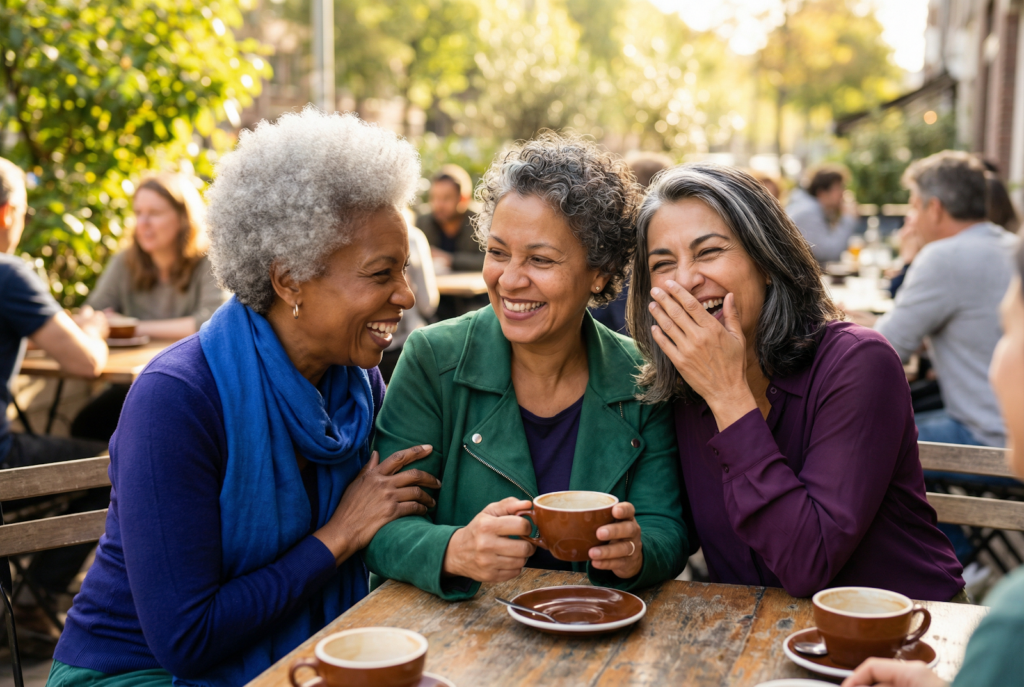
4. Master the Art of the Polite Interruption: Claim Your Voice
How many times have you been in a conversation, waiting for the perfect moment to speak, only to have it never arrive? Women are often socialized to be polite and wait their turn, but in many professional and social settings, that means we never get to speak at all. It’s time to master the art of the polite interruption. This isn’t about being rude; it’s about asserting your right to be part of the conversation.
Use phrases like, “If I could just jump in here for a moment,” or “That’s an interesting point, and it makes me think of…” Then, state your opinion or idea with confidence. Don’t apologize for having a perspective. Don’t preface your thoughts with “This might be a silly idea, but…” Your ideas are not silly. Your experience is not irrelevant. Your voice deserves to be heard. This is a crucial skill for women who feel invisible after 50 in professional environments where their experience and wisdom are being overlooked [9].
5. Dress for the Woman You Are Becoming
Your wardrobe is a powerful tool for self-expression. For years, you may have dressed to fit in, to be appropriate for your job, or to not draw too much attention to yourself. Now is the time to dress for yourself. What makes you feel powerful? What makes you feel joyful? What makes you feel like the most authentic version of you? Whether it’s a brightly colored jacket, a bold piece of jewelry, or a fabulous pair of boots, your clothing can be a way to signal to the world — and to yourself — that you are not fading into the background.
This isn’t about chasing trends or trying to look younger. It’s about developing a personal style that reflects your inner vitality and helps you to reclaim your spark. Research on the psychology of clothing shows that what we wear significantly influences our mood, our confidence, and how others perceive us. When you dress with intention, you’re not just choosing an outfit — you’re choosing how you want to show up in the world. And showing up, fully and unapologetically, is the most powerful antidote to invisibility there is.
Building a Life Where You’re Seen: The Long Game
Reclaiming your visibility isn’t a one-time event; it’s an ongoing practice. It requires a daily commitment to choosing yourself, your voice, and your presence. Some days it will feel effortless. Other days, the old feelings of being invisible after 50 will creep back in, and that’s okay. The goal isn’t perfection; it’s progress. Each small act of showing up — each time you take up space, speak your truth, or invest in a friendship that nourishes you — is a vote for the woman you’re becoming.
It’s also worth acknowledging the broader cultural work that needs to happen. The fact that so many women feel invisible after 50 is not a personal problem; it’s a societal one. As more of us refuse to be erased, as more of us speak up and take up space, we collectively shift the narrative. We become visible not just for ourselves, but for every younger woman who will one day stand where we stand. Our visibility is an act of intergenerational solidarity.
The research on generativity — the psychological concept of contributing to the next generation and to society — suggests that finding ways to share our wisdom and experience is one of the most powerful pathways to well-being in the second half of life [1]. When we stop shrinking and start sharing, we don’t just help ourselves; we help the world. Your experience, your hard-won wisdom, your perspective — these are gifts. Don’t keep them hidden.
Quote Graphic | Alt text: Quote graphic on a deep plum background with gold botanical accents reading: ‘You are not invisible. You are a woman in the middle of becoming.’ — Midlife Wellness
Conclusion: Your Second Act Is Not a Dress Rehearsal
The experience of feeling invisible after 50 is a painful but common chapter in many women’s lives. It is a reflection of a society that has not yet fully learned to value the wisdom, power, and beauty of women in their second act.
But it does not have to be your permanent reality. By understanding the forces at play — both social and biological — and by taking intentional, strategic action, you can refuse to be erased.
You can learn to take up space, to speak with authority, and to build a life that is rich with purpose and connection.
This journey is not about fighting against aging; it’s about embracing the freedom and power that come with it. It’s about shedding the expectations of others and stepping into a more authentic version of yourself.
The women who stop feeling lonely and invisible are not the ones who found a magic formula — they’re the ones who decided, one day, that they were worth being seen. That decision is available to you right now, in this moment.
Remember: your worth is not determined by your age, your hormonal status, or your ability to command the attention of others. Your worth is inherent.
You are not invisible. You are a woman in the middle of becoming — and that is one of the most extraordinary things a person can be.
References
[1] G. Saltz, “Age-related Gendered Diminishment: toward understanding and interventions for a common psychological experience in post-midlife women,” Frontiers in Psychology, vol. 16, Apr. 1, 2025. [Online]. Available: https://doi.org/10.3389/fpsyg.2025.1535145
[2] Gransnet, “Feeling Invisible Survey Data Results,” 2016. [Online]. Available: https://www.gransnet.com/online-surveys-product-tests/feeling-invisible-survey-data-results
[3] GenM, “The Invisibility Report,” 2021. [Online]. Available: https://gen-m.com/wp-content/uploads/2021/09/GenM-Invisibility-Report.pdf
[4] S. Sontag, “The Double Standard of Aging,” in The Sociology of Gender: An Introduction to Theory and Research, 2018.
[5] “Oxytocin and Women’s Health in Midlife,” PMC, National Center for Biotechnology Information. [Online]. Available: https://pmc.ncbi.nlm.nih.gov/articles/PMC11404667/
[6] “Loneliness and Social Isolation Can Take a Toll on Women’s Cognitive Abilities,” The Menopause Society, Mar. 11, 2026. [Online]. Available: https://menopause.org/press-releases/loneliness-and-social-isolation-can-take-a-toll-on-womens-cognitive-abilities
[7] National Institute on Aging, “Social isolation, loneliness in older people pose health risks,” [Online]. Available: https://www.nia.nih.gov/news/social-isolation-loneliness-older-people-pose-health-risks
[8] S. Westwood, “‘It’s the not being seen that is most tiresome’: Older women, invisibility and social (in)justice,” Journal of Women & Aging, vol. 35, no. 5, pp. 535–548, 2023. [Online]. Available: https://doi.org/10.1080/08952841.2023.2197658
[9] B. Steffan, “Managing menopause at work: The contradictory nature of identity talk,” Gender, Work & Organization, vol. 28, no. 4, pp. 1433–1450, 2021. [Online]. Available: https://doi.org/10.1111/gwao.12539
[10] J. Sergeant and R. Rizq, “‘Its all part of the big CHANGE’: a grounded theory study of women’s identity during menopause,” Journal of Psychosomatic Obstetrics & Gynaecology, vol. 38, no. 4, pp. 295–304, 2017. [Online]. Available: https://doi.org/10.1080/0167482X.2016.1270937
[11] GenM and IFF, “USA Invisibility Report,” 2024. [Online]. Available: https://healthsciences.iff.com/fileadmin/user_upload/Editor/Documents/GenM_IFF_USA_Invisibility_Report_2024.pdf