

Table of Contents
Introduction: Drowning in Advice? You’re Not Alone
It starts with a simple question. Maybe you’re wondering why you can’t sleep through the night anymore, or why your favorite jeans suddenly feel snug. You type “menopause symptoms” into a search bar, and suddenly, you’re drowning. Articles, blog posts, influencers, and so-called experts flood your screen with conflicting advice. One says hormone therapy is a miracle cure; another claims it’s dangerous. Eat more soy. Less soy. No soy. It’s enough to make your head spin. If you’re feeling overwhelmed by menopause information overload, you’re not imagining it—you’re experiencing a very real phenomenon.
In fact, menopause information overload is becoming increasingly common as more women turn to the internet for guidance on health issues related to menopause.
Managing menopause information overload effectively can empower you to make informed decisions without feeling overwhelmed by the influx of data.
Understanding the concept of menopause information overload is crucial for navigating this phase of life and making sense of the information available.
Many women experience menopause information overload, which complicates their understanding of the changes they face during this significant transition.
It’s essential to find ways to manage menopause information overload for better mental clarity during this transition.
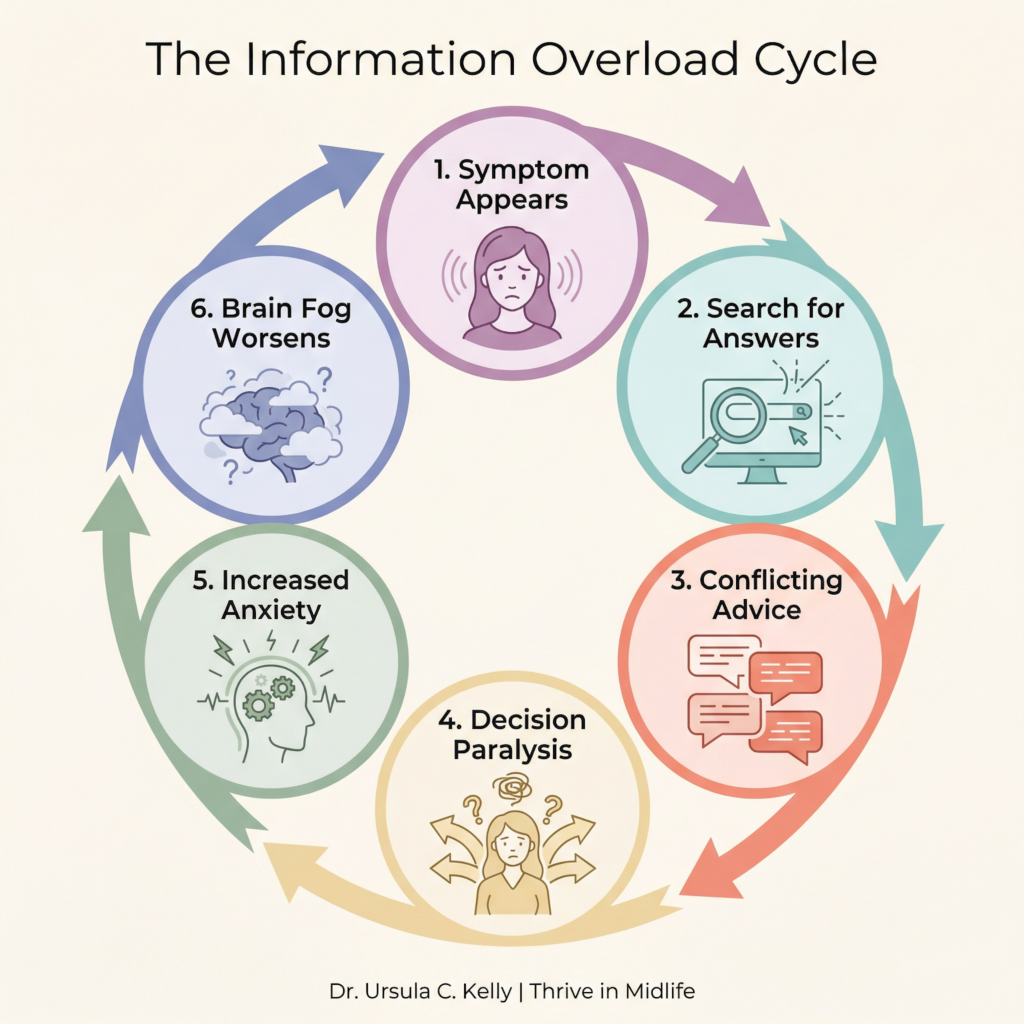
This feeling of paralysis is common for women navigating menopause. The sheer volume of conflicting advice, combined with the very real cognitive difficulties in perimenopause, can make decisions feel impossible. But you don’t have to stay stuck. In this article, we’ll cut through the noise and give you tools to reclaim your clarity. We’ll explore the impact of perimenopause on cognition, share pro tips for your journey, and show you that you’re not alone. By the end, you’ll have a clear path forward, free from menopause information overload.
Try our new tool…
The Science Behind the Overwhelm: Understanding the Impact of Perimenopause on Cognition
If you feel like your brain has been hijacked, you’re not far off. The cognitive changes you’re experiencing are not just in your head; they’re a direct result of the hormonal fluctuations of perimenopause. Research shows that up to two-thirds of women experience some degree of menopause-related cognitive impairment, often referred to as “brain fog” [4]. This isn’t a sign of personal failure; it’s a physiological response to the decline in estrogen, a hormone that plays a crucial role in brain function. Estrogen helps with verbal memory, processing speed, and overall cognitive clarity [2]. When estrogen levels start to fluctuate and decline, it’s no wonder you feel like you’re thinking through a thick fog.
This cognitive disruption is why menopause information overload feels so debilitating. It’s not just that there’s a lot of information—your brain is having a harder time processing it all. A study in Current Psychiatry Reports found that verbal learning and memory are the cognitive functions most negatively affected during perimenopause [2]. When you’re trying to read and retain information from multiple sources, your brain works overtime. This leads to decision fatigue, where the sheer number of choices becomes so overwhelming you can’t make any choice at all. It’s a vicious cycle: the more you search, the more overwhelmed you feel.
To counter menopause information overload, focus on trusted sources and take breaks from excessive reading.
Finding reliable menopause information can help alleviate the feelings associated with menopause information overload.
Engaging with a professional can also help combat menopause information overload and provide clarity.
Pro Tip: The One-Thing-at-a-Time Rule
Evaluating the sources can reduce the effects of menopause information overload significantly.
When you’re feeling overwhelmed, the best thing you can do is to simplify. Instead of trying to tackle everything at once, focus on one thing at a time. Pick one symptom that’s bothering you the most and focus your research on that. Once you’ve made a decision about how to address that one symptom, you can move on to the next. This approach can help you feel more in control and less paralyzed by the endless stream of information.
Recognizing the signs of menopause information overload is the first step towards addressing it effectively.
Many women report feeling lighter after discussing their experiences with menopause information overload.
Cutting Through the Noise: How to Find Credible Menopause Information
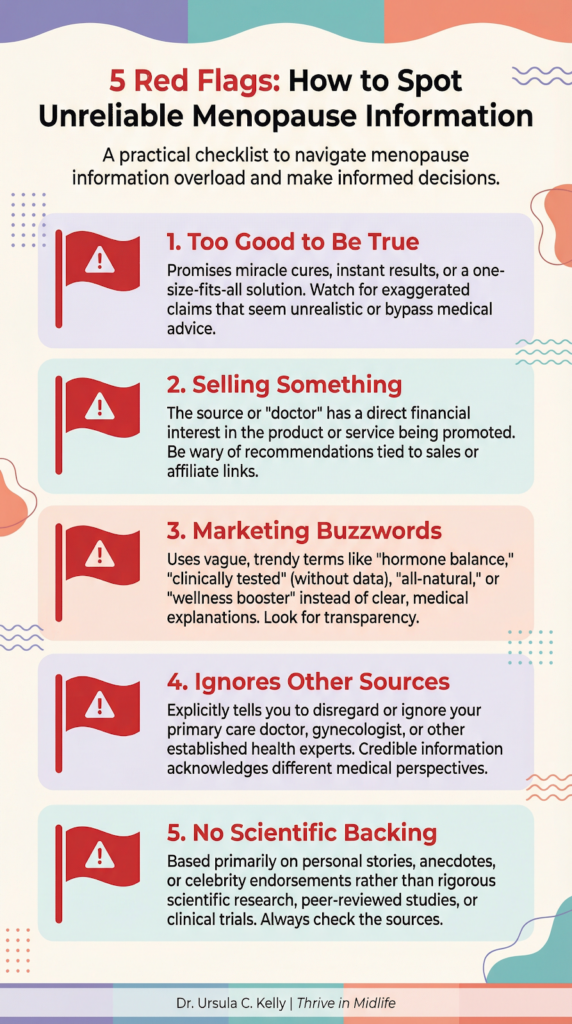
In the age of the internet, everyone’s an expert. But when it comes to your health, it’s crucial to be discerning about where you get your information. The American College of Obstetricians and Gynecologists (ACOG) warns that many online sources are from self-proclaimed experts, not evidence-based sources [1]. So, how do you separate the wheat from the chaff? Start by looking for information from reputable medical organizations like ACOG, the North American Menopause Society (NAMS), and the World Health Organization (WHO). These organizations base their recommendations on a thorough review of the scientific evidence, not on personal anecdotes or financial interests.
Utilizing the power of journaling can help clarify thoughts muddled by menopause information overload.
Be wary of marketing buzzwords and miracle cures. If something sounds too good to be true, it probably is. Phrases like “hormone balance,” “doctor-approved,” and “clinically tested” can be misleading. “Clinically tested” is not the same as “clinically proven,” and “doctor-approved” can be meaningless when anyone can call themselves an expert [1]. Instead, look for information that is balanced, nuanced, and acknowledges both the benefits and risks of any treatment. A credible source will not promise a quick fix or tell you to ignore all other sources of information. They will empower you with knowledge and encourage you to have an open conversation with your healthcare provider.
Pro Tip: The “Who Benefits?” Question
When you’re evaluating a piece of information, ask yourself, “Who benefits from this?” Is it a company trying to sell you a product? An influencer trying to grow their following? Or a medical professional trying to empower you with knowledge? This simple question can help you identify potential conflicts of interest and steer you toward more reliable sources.
The Unseen Symptom: Cognitive Difficulties in Perimenopause
While hot flashes and night sweats get all the attention, the cognitive difficulties in perimenopause can be just as disruptive, if not more so. A study in the Journal of the North American Menopause Society found that 60% of women reported a decline in their cognitive abilities during menopause [2]. This can manifest as difficulty concentrating, memory lapses, and a general feeling of being mentally “off.” These symptoms can be particularly distressing for women who have always been sharp and on top of their game. It can make you feel like you’re losing your edge, both personally and professionally.
Taking time to process information can help alleviate the burden of menopause information overload.
The good news is that for most women, these cognitive changes are temporary. As your body adjusts to its new hormonal reality, the brain fog typically lifts. In the meantime, there are things you can do to support your brain health. Lifestyle changes like a healthy diet, regular exercise, and good sleep hygiene can make a big difference [4]. The Mediterranean diet, in particular, has been shown to be beneficial for brain health, thanks to its high concentration of omega-3 fatty acids and unsaturated fats [4]. And don’t underestimate the power of movement. Even light exercise, like a daily walk or a gentle yoga class, can improve both memory and mood [4].
Participating in discussions about menopause information overload can lead to shared strategies for coping.
In conclusion, tackling menopause information overload requires intentional strategies and community support.

Pro Tip: The Brain-Dump Technique
When your brain feels full, get it all out on paper. Before you go to bed, take a few minutes to write down everything that’s on your mind: your to-do list, your worries, your half-formed ideas. This “brain dump” can help clear your mental clutter and make it easier to fall asleep. A good night’s sleep is one of the most powerful things you can do to support your cognitive function.
You Are Not Alone: Understanding Menopause Related Symptoms Demographic
It’s easy to feel isolated when you’re going through menopause, but the reality is that you’re part of a massive global community. In 2021, women aged 50 and over accounted for 26% of all women and girls globally, up from 22% just 10 years earlier [3]. That’s a huge number of women who are navigating the same challenges and asking the same questions as you are. And the numbers are only growing. The global population of postmenopausal women is increasing, and women are living longer than ever before. A woman aged 60 in 2019 could expect to live, on average, another 21 years [3].
This demographic shift has a profound impact on how we think about and talk about menopause. It’s no longer a topic to be whispered about in hushed tones; it’s a major public health issue that deserves our attention. The fact that so many women are experiencing menopause at the same time is a powerful force for change. It’s driving more research, more innovation, and more open conversations about what it means to be a woman in midlife. So, the next time you’re feeling alone in your struggle, remember that you’re part of a global sisterhood. Your experience is valid, your questions are important, and your voice matters.
Ultimately, recognizing and addressing menopause information overload is crucial for mental wellness.
Pro Tip: The Power of Community
Find your people. Whether it’s an online forum, a local support group, or just a few trusted friends, connecting with other women who are going through the same thing can be incredibly validating and empowering. Sharing your experiences and hearing from others can help you feel less alone and more hopeful about the road ahead.
Conclusion: Your Path to Clarity and Confidence
Navigating the menopause transition in the age of information overload can feel like a daunting task. But you don’t have to do it alone, and you don’t have to have all the answers at once. By focusing on credible sources, being critical of the information you consume, and taking a one-step-at-a-time approach, you can cut through the noise and find the clarity you’re looking for. Remember, this is your journey, and you are in the driver’s seat. Trust your intuition, listen to your body, and don’t be afraid to ask for help.
If you’re ready to learn more, check out my book on Amazon: The Menopause Brain Reset
Credible Sources to Stop Menopause Information Overload
1. The Menopause Society – Patient Education Resources
URL:https://menopause.org/patient-education
2. Mayo Clinic Press – Lesser-Known Menopause Symptoms
3. Harvard Health Publishing – Menopause and Perimenopause Guide
URL:https://www.health.harvard.edu/a_to_z/menopause-and-perimenopause-a-to-z
4. Johns Hopkins Medicine – Introduction to Menopause
URL:https://www.hopkinsmedicine.org/health/conditions-and-diseases/introduction-to-menopause
5. MedlinePlus – Evaluating Internet Health Information Tutorial
URL:https://medlineplus.gov/webeval/webeval.html
Frequently Asked Questions:
What supplements are good for menopause brain fog?
– Omega-3 fatty acids
– Ginkgo biloba
– Vitamin D
– B vitamins (especially B6 and B12)
– Magnesium
– Phosphatidylserine
– L-theanine
– Rhodiola rosea
– Ashwagandha
Can menopause cause sensory overload?
Yes, menopause can cause sensory overload due to hormonal changes that affect mood, stress levels, and sensory processing.
How can menopause affect you intellectually?
Menopause can affect intellectual functioning by causing symptoms such as memory lapses, difficulty concentrating, and decreased cognitive speed. Hormonal changes during this time may contribute to these cognitive challenges.
Can menopause cause you to say wrong words?
Yes, menopause can lead to cognitive changes, including difficulty finding the right words or experiencing word-finding problems.
References
[1] N. Santoro, “Menopause Misinformation Is Everywhere. Here’s How to Detect It,” ACOG, 2023. [Online]. Available: https://www.acog.org/womens-health/experts-and-stories/the-latest/menopause-misinformation-is-everywhere-heres-how-to-detect-it
[2] C. A. Metcalf, K. A. Duffy, C. E. Page, and A. M. Novick, “Cognitive Problems in Perimenopause: A Review of Recent Evidence,” Curr Psychiatry Rep, vol. 25, no. 10, pp. 501–511, 2023.
[3] “Menopause,” World Health Organization, Oct. 16, 2024. [Online]. Available: https://www.who.int/news-room/fact-sheets/detail/menopause
[4] E. M. Glazier and E. Ko, “Many women have cognition issues during menopause,” UCLA Health, Sep. 29, 2021. [Online]. Available: https://www.uclahealth.org/news/article/many-women-have-cognition-issues-during-menopause
[5] R. Pope, “Navigating the Menopause Maze: Finding Clarity in the Noise,” Our Womanity, Oct. 17, 2024. [Online]. Available: https://ourwomanity.com/navigating-the-menopause-maze-finding-clarity-in-the-noise/