

Table of Contents
You’re Not Lost, You’re Unearthing a New You: An Introduction to Finding Yourself After Menopause
Have you ever looked in the mirror and wondered, “Who is that person looking back at me?” If you’re a woman in midlife, navigating the choppy waters of menopause, that feeling might be all too familiar.
One moment, you’re juggling a career, family, and a million other responsibilities. The next, the kids are grown, your body is changing in ways you never expected, and the roles that once defined you feel like they’re slipping through your fingers. It’s a disorienting experience that can leave you feeling adrift, questioning your identity and purpose.
If you’re struggling with finding yourself after menopause, please know you’re not alone. This is a common, though often unspoken, part of the journey. The good news? This isn’t an ending. It’s a powerful, transformative beginning. This is your chance to rediscover and redefine who you are on your own terms.
It’s time to start the incredible journey of finding yourself after menopause and embracing the vibrant woman you are becoming.
The Great Identity Shift: Understanding the Sense of Loss in Menopause
Losing your sense of self during menopause isn’t just “all in your head.” It’s a complex interplay of biological, psychological, and social factors that can shake the very foundation of who you believe you are.
For years, your identity has been shaped by your roles: mother, partner, daughter, professional, caregiver. But as you enter midlife, these roles often shift dramatically. The children you’ve poured your heart and soul into may be leaving the nest, your career path might be changing, and you may find yourself caring for aging parents.
It’s a period of profound transition, and it’s happening at the exact same time your body is undergoing its own seismic shift.
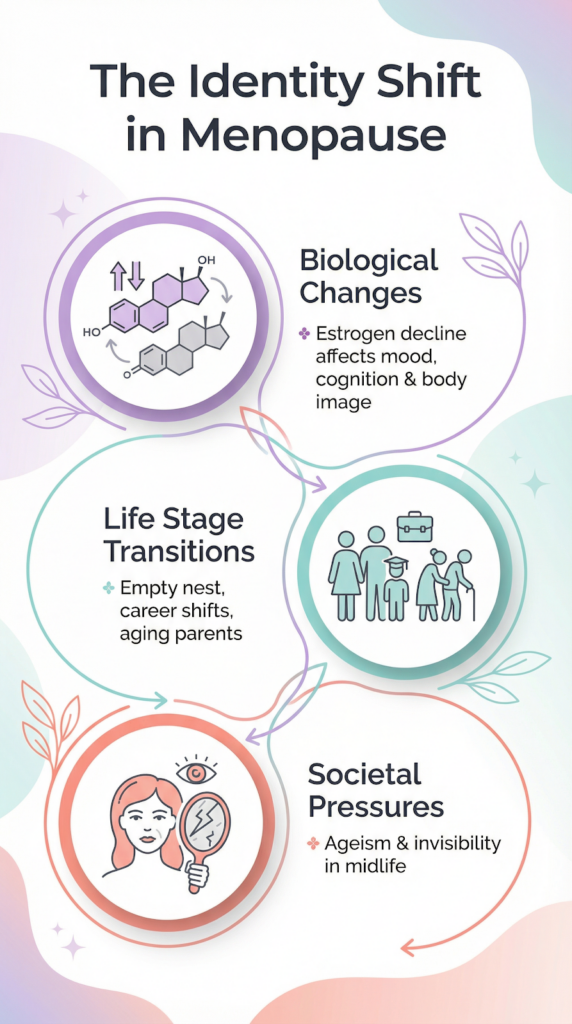
Hormonal fluctuations, particularly the decline in estrogen, can directly impact your mood, cognitive function, and even your physical appearance. The brain fog that makes it hard to concentrate at work, the mood swings that leave you feeling irritable and unlike your usual calm self, and the physical changes that alter your body image can all contribute to a feeling of being a stranger in your own skin.
When you don’t feel like yourself physically or emotionally, it’s no wonder your sense of identity feels unstable. This experience is compounded by societal pressures and a culture that often glorifies youth, leaving many women feeling invisible and devalued as they age.
It’s a perfect storm that can lead to a deep and unsettling sense of loss. But understanding these forces is the first step toward reclaiming your identity and finding yourself after menopause.
The Science Behind the Shift: Hormones and Identity
It’s crucial to recognize that the emotional and psychological challenges of menopause have a real biological basis. The hormonal rollercoaster of perimenopause and menopause doesn’t just trigger hot flashes and night sweats; it rewires your brain.
Estrogen, for example, plays a vital role in regulating neurotransmitters like serotonin and dopamine, which are essential for mood stability and feelings of pleasure and motivation. When estrogen levels decline, it can disrupt this delicate chemical balance, leading to increased anxiety, irritability, and a general feeling of flatness or loss of joy.
This isn’t a personal failing; it’s a physiological response to a significant biological event. Understanding this can help you approach your feelings with self-compassion rather than self-criticism, a key step in the journey of finding yourself after menopause.
Grieving the “Old You” to Embrace the New
It’s okay to grieve the person you were. In fact, it’s a necessary part of the process. You’re letting go of a version of yourself that you knew and understood for a long time. There can be a real sense of grief for the physical body you once had, the roles that once defined you, and the future you had envisioned.
Allowing yourself to feel this loss without judgment creates space for something new to emerge. This isn’t about erasing your past but integrating it into a new, more expansive version of yourself.
This period of transition is an invitation to turn inward, to get quiet, and to listen to the whispers of the woman you are becoming. It’s in this space of compassionate acceptance that the journey of finding your purpose in life truly begins.
Your Second Act: 7 Powerful Secrets for Finding Your Purpose in Life After Menopause
Menopause isn’t a pause button; it’s a reset. After decades of focusing on the needs of others, this is your time. This is the chapter where you get to be the protagonist of your own story. But where do you start? The prospect of finding your purpose in life can feel daunting, especially when you’re already feeling lost.
The secret is to start small, get curious, and treat it as an adventure of self-discovery. This isn’t about finding one single, grand purpose that will define the rest of your life. It’s about weaving a rich tapestry of meaning, joy, and connection that is uniquely yours.
Here are seven powerful secrets to guide you on your path to finding yourself after menopause and creating a second act that is even more fulfilling than the first.
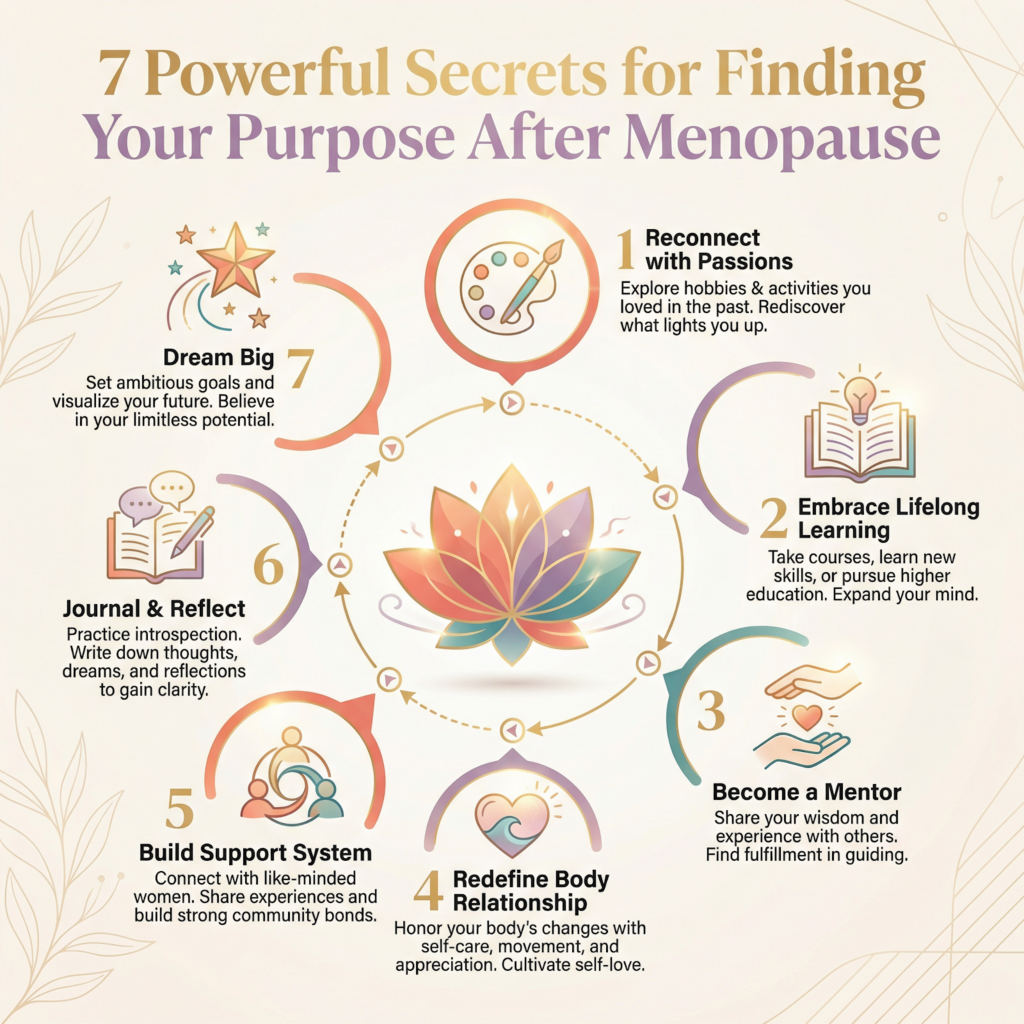
1. Get Curious and Reconnect with Your Passions
Think back to the person you were before you became a wife, a mother, or a high-achieving professional. What did she love to do? What lit her up? Maybe it was painting, dancing, writing, or spending hours lost in a good book.
Your passions are the breadcrumbs that can lead you back to yourself. Make a list of everything you’ve ever enjoyed, no matter how silly or insignificant it may seem. Then, pick one and schedule it into your calendar as a non-negotiable appointment with yourself.
Re-engaging with old hobbies or exploring new ones is a powerful way to reconnect with your core self and add new, vibrant layers to your identity.
2. Embrace the Power of Lifelong Learning
Have you always wanted to learn Italian, master the art of pottery, or understand the stock market? Now is the perfect time. Engaging in lifelong learning is not only a fantastic way to keep your brain sharp and combat menopause-related brain fog, but it’s also a powerful tool for boosting happiness and expanding your sense of self.
When you challenge yourself to learn something new, you build new neural pathways and prove to yourself that you are still capable of growth and change. Sign up for a local class, enroll in an online course, or simply head to the library and dive into a new subject.
Every new skill you acquire is a step toward building a more confident and multifaceted you.
3. Step into the Role of Mentor
One of the most profound ways to find purpose is to share your wisdom and experience with others. You have a lifetime of knowledge, both personal and professional, that is incredibly valuable.
Becoming a mentor allows you to pay it forward and make a real difference in someone else’s life. This could be formally, through a program at your workplace, or informally, by taking a younger colleague under your wing or offering guidance to a new mom in your neighborhood.
Mentorship not only fosters a deep sense of connection and purpose but has also been shown to improve mental well-being and reduce feelings of depression. In helping others, you often end up helping yourself the most.
4. Redefine Your Relationship with Your Body
Your body has been through a lot, and it’s easy to get caught up in a narrative of loss and decline during menopause. But what if you could shift your perspective?
Instead of focusing on what your body can no longer do, what if you celebrated what it can do? This is the time to explore new forms of movement that bring you joy and make you feel strong and empowered.
Maybe it’s yoga, hiking, strength training, or dancing around your living room. The goal isn’t to look a certain way but to feel good in your own skin. Nourish your body with healthy foods, prioritize rest, and treat yourself with the same kindness and compassion you would offer a dear friend.
A positive relationship with your body is fundamental to finding yourself after menopause.

5. Cultivate a Strong Support System
Menopause can be an incredibly isolating experience, but it doesn’t have to be. You are not on this journey alone. Now more than ever, it’s crucial to surround yourself with a strong support system of women who get it.
Seek out friends who uplift you, join a menopause support group, or find an online community where you can share your experiences without judgment. Openly communicating with your partner and family about what you’re going through can also foster greater understanding and support.
Connection is the antidote to isolation, and sharing your story can be incredibly healing, both for you and for the women you share it with.
6. Explore Your Inner World Through Journaling and Reflection
Sometimes, the answers we’re looking for are already inside us, waiting to be discovered. Journaling is a powerful tool for self-reflection and can help you gain clarity on your thoughts, feelings, and desires.
You don’t have to be a great writer to benefit from it. Simply set aside 10-15 minutes each day to free-write whatever is on your mind. You can use prompts to guide you, such as: “What brings me joy?”, “What am I most proud of?”, “If I weren’t afraid, I would…”.
This practice of turning inward can help you untangle the confusing emotions of menopause and reconnect with your own inner wisdom, a critical part of finding your purpose in life.
7. Give Yourself Permission to Dream Big
This is your time to be gloriously, unapologetically selfish. After years of putting others first, you have permission to prioritize your own dreams and desires.
What have you always wanted to do, be, or have? Start a business? Write a book? Travel the world? No dream is too big or too small. Allow yourself to fantasize about your ideal future without worrying about the “how.”
Create a vision board, write a bucket list, or simply let your mind wander. The act of dreaming reconnects you with your deepest desires and reminds you that your life is full of possibility.
This isn’t about abandoning your responsibilities but about making space for your own fulfillment. This is the essence of life in menopause—a chance to create a life that is truly your own.
A New Chapter Awaits: Embracing Your Evolving Identity
As you navigate the journey of finding yourself after menopause, remember that your core self is not gone. She has been there all along, waiting patiently for you to rediscover her.
The woman you are becoming is not a replacement for the woman you were but an evolution. She is a composite of all your experiences, wisdom, and resilience, layered with new passions, a deeper sense of purpose, and a newfound freedom.
This is your opportunity to shed the roles and expectations that no longer serve you and step into a more authentic and fulfilling way of being.
This process of self-discovery is not a linear path. There will be days when you feel confident and clear, and days when you feel lost all over again. That’s okay. Be patient and compassionate with yourself.
Celebrate the small wins, lean on your support system, and trust that you are exactly where you need to be. The journey of finding yourself after menopause is one of the most profound and rewarding adventures of your life. It’s a return to yourself.
If you’re ready to take the next step on your journey of transformation and connect with a community of women who are also navigating this powerful life stage, I invite you to explore our FREE 5-Day Menopause Brain Reset Course.
It’s a gentle introduction to reclaiming your mental clarity and emotional balance. And if you’re seeking a deeper, more comprehensive transformation, our 90-Day Transformational Course offers a roadmap to not just survive but thrive during menopause and beyond.
You don’t have to do this alone. Join a community of women who are ready to embrace their second act with courage, confidence, and joy.
Additional Resources and Expert Guidance
1. Harvard Medicine Magazine – The Mental Health Aspects of Menopause
URL: https://magazine.hms.harvard.edu/articles/mental-health-aspects-menopause
2. National Institute on Aging (NIH ) – Menopause
URL: https://www.nia.nih.gov/health/menopause
3. The Menopause Society (formerly North American Menopause Society )
4. Cleveland Clinic – Emotional Aspects of Menopause
5. Mayo Clinic – Self-Esteem: Take Steps to Feel Better About Yourself
URL: https://www.mayoclinic.org/healthy-lifestyle/adult-health/in-depth/self-esteem/art-20045374
References
Citations
- A. A. Deeks and M. P. McCabe, “Well-being and menopause: an investigation of purpose in life, self-acceptance and social role in premenopausal, perimenopausal and postmenopausal women,” Quality of Life Research, vol. 13, no. 2, pp. 389–398, Mar. 2004. [Online]. Available: https://pubmed.ncbi.nlm.nih.gov/15085911/
- Vhi, “Menopause & identity: how to regain a sense of self,” Vhi Blog, Apr. 17, 2024. [Online]. Available: https://www1.vhi.ie/
- Let’s all Talk Menopause, “Finding ‘You’ again – Identity shifts in menopause,” Let’s all Talk Menopause Blog, Nov. 17, 2025. [Online]. Available: https://www.letsalltalkmenopause.co.uk/blog/identityshifts
- B. C. Shu, W. M. Luh, S. M. Li, and S. Y. Lu, “Self-concept and menopause among mid-life women: A survey in southern Taiwan,” Maturitas, vol. 57, no. 2, pp. 188–195, Jun. 2007.
- Stanford Medicine, “Finding Purpose in Midlife and Beyond,” Lifestyle Medicine, Jan. 24, 2025. [Online]. Available: https://lifestylemedicine.stanford.edu/finding-purpose-in-midlife/
- Bonafide, “Finding Your Purpose in Life in Menopause,” Bonafide Blog, Sep. 11, 2025. [Online]. Available: https://hellobonafide.com/blogs/news/finding-purpose-menopause
- T. D. Brower, “Learning Is A Sure Path To Happiness And Engagement: Here’s How To Start,” Forbes, Oct. 17, 2021.
- Greater Good Science Center at UC Berkeley, “Here’s How to Find Meaning in Your Midlife Crisis,” Greater Good Magazine, Mar. 11, 2020. [Online]. Available: https://greatergood.berkeley.edu/
- J. Sergeant, S. Rizq, and R. G. Priest, “‘Its All Part of the Big CHANGE’: A Grounded Theory Study of Women’s Identity During Menopause,” Journal of Women & Aging, vol. 29, no. 5, pp. 439–451, Sep. 2017. [Online]. Available: https://pubmed.ncbi.nlm.nih.gov/28067092/