

Table of Contents
When the Fear That Menopause Decline Is Permanent Feels All Too Real
If you’re waking up at 3 a.m. with your heart racing, staring at the ceiling, and wondering if your brain will ever feel sharp again, you’re not alone. So many women in their late forties and fifties ask me, “Is menopause decline permanent?” It’s a terrifying thought. You might be forgetting names, losing your train of thought mid-sentence, or feeling an exhaustion so deep it settles into your bones. It’s completely natural to worry that this is just how life is going to be from now on. But I want to tell you right now: it’s not.
The fear that you’re losing your edge is one of the most common—and most heartbreaking—parts of this transition. When you’re in the thick of it, the changes feel so overwhelming that it’s easy to believe they’re irreversible. But the science tells a very different, incredibly hopeful story. Whether you’re asking “is menopause decline permanent” because of brain fog, weight gain, mood changes, or sheer exhaustion, the answer is the same: your brain and body aren’t breaking down; they’re going through a profound, temporary rewiring process.
In this post, we’re going to walk through seven powerful, science-backed truths that will help you stop asking “is menopause decline permanent” and start building a plan for your most vibrant chapter yet. We’ll cover the real symptoms of menopause, how long does menopause last, when the transition to menopause begins, and how to navigate perimenopause and menopause with confidence. And if you’re ready to take action right now, my FREE 5-Day Menopause Brain Reset Course is designed to give you the tools to start feeling like yourself again.
Secret #1: Understanding the Real Symptoms of Menopause
When we talk about the symptoms of menopause, we often focus on the physical discomforts like hot flashes and night sweats. But for many women, the neurological and emotional shifts are far more distressing—and far more likely to fuel the fear that is menopause decline permanent. You might be experiencing a combination of brain fog, mood swings, anxiety, and profound fatigue. These aren’t signs of permanent damage. They are the direct result of your brain adapting to fluctuating hormone levels, particularly the drop in estrogen.
The symptoms of menopause are wide-ranging and deeply personal. Some women sail through with minimal disruption; others feel as though they’ve been hit by a hormonal freight train. The most commonly reported symptoms include irregular periods, hot flashes, night sweats, sleep disruption, mood changes, brain fog, vaginal dryness, weight changes, headaches, and reduced libido. Research suggests that up to two-thirds of women experience some degree of cognitive symptoms during the menopausal transition [1]. Knowing that your experience is both real and shared is the first step toward healing—and toward answering the question “is menopause decline permanent?” with a confident no.
Your Brain on Estrogen: What’s Actually Happening
Estrogen isn’t just a reproductive hormone; it’s a master regulator in your brain. It helps manage energy production, mood, and memory. When estrogen levels start to roller-coaster and eventually decline, your brain temporarily loses some of its metabolic efficiency [2]. This is why you feel that heavy, thick brain fog and why your memory might feel like a sieve. It’s a neurological transition state, much like puberty, where the brain is actively remodeling itself [3]. The symptoms of menopause that feel so debilitating right now are part of an adaptation phase, not a permanent decline.
Think of it this way: your brain has been running on a particular fuel source for decades. When that fuel starts to change, there’s an adjustment period. Your neurons are literally learning to operate differently. This is uncomfortable, disorienting, and sometimes frightening—but it is not permanent. Understanding this distinction is crucial for anyone asking “is menopause decline permanent?” The answer lies in the biology: your brain is adapting, not deteriorating.
The Adaptation Phase: Your Brain’s Remarkable Resilience
The incredible news is that your brain is highly adaptable. While the initial drop in estrogen causes a temporary energy crisis in the brain, your neurons eventually learn to use alternative fuel sources. Groundbreaking research from Dr. Lisa Mosconi and her team at Weill Cornell Medicine found that brain biomarkers largely stabilized post-menopause, and there was even evidence of gray matter volume recovering in key brain regions for cognitive aging [4]. This means your brain isn’t just surviving the transition—it’s actively rebuilding. So when you ask “is menopause decline permanent,” the neuroscience says no.
“That doesn’t mean the brain gets worse — it just adapts to the loss of estrogen. And during that adaptation, some women experience symptoms.” — Dr. Kejal Kantarci, Mayo Clinic
Secret #2: How Long Does Menopause Last? The Timeline That Will Give You Hope
One of the most urgent questions I hear is, “How long does menopause last?” When you’re suffering, even one more day feels like an eternity. It’s important to understand the timeline so you can give yourself grace and know that there is a light at the end of the tunnel. The transition isn’t a quick switch; it’s a gradual process that unfolds over several years. And understanding how long does menopause last is one of the most powerful antidotes to the fear that is menopause decline permanent.
When you know there’s a defined period with a beginning, middle, and end, you can stop asking “is menopause decline permanent” and start asking “how do I support myself through this transition?” That shift in perspective is genuinely transformative. You move from victim to navigator. From passive sufferer to active participant in your own recovery.
Try Our New Tool
The Three Stages and What to Expect
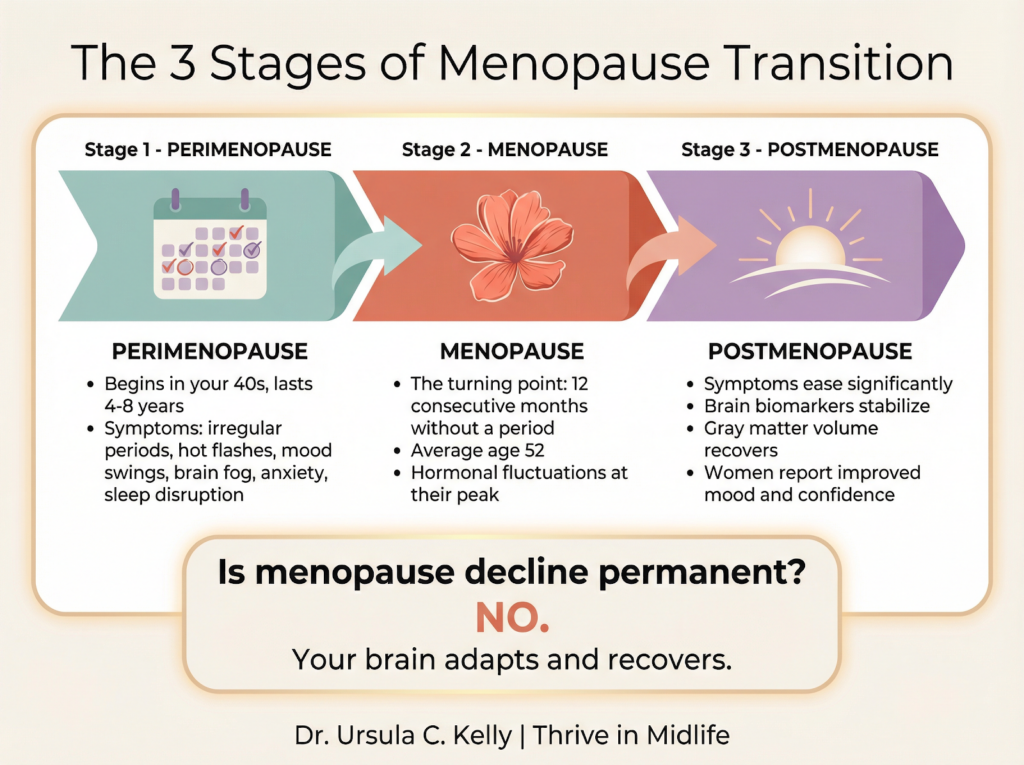
The menopausal journey unfolds in three distinct stages. Perimenopause is the transition phase that can begin eight to ten years before your final period, typically starting in your early to mid-forties. This is when hormonal fluctuations are most chaotic and symptoms are often at their most intense. Menopause itself is technically a single moment in time—the point at which you’ve gone 12 consecutive months without a period, with an average age of 52 [5]. Postmenopause is everything that comes after, and it’s where most women find significant relief from the symptoms that made them wonder: is menopause decline permanent?
The entire menopausal transition, from the first subtle shifts to the final cessation of periods, typically spans four to eight years [5]. For some women, it can be shorter, and for others, it might stretch a bit longer. The most intense symptoms usually cluster around the late perimenopause and early postmenopause stages. While seven years might sound daunting, remember that the severity of symptoms fluctuates and generally improves significantly once your body reaches its new hormonal baseline. How long does menopause last in terms of severe symptoms? For most women, the worst of it is concentrated in a two-to-three-year window around the final period.
The Postmenopause Relief: What Research Really Shows
Once you cross the threshold into postmenopause, the chaotic hormonal fluctuations finally settle down. This is when many women report a profound lifting of the fog. The question “is menopause decline permanent” begins to fade as energy returns and cognitive clarity improves. A landmark 20-year longitudinal study from the University of Melbourne found that both negative mood and depressive symptoms decreased significantly across the years after menopause [6]. Women reported feeling more patient, less tense, and less withdrawn as they entered their sixties.
The researchers found that women felt more in control of their lives, more financially stable, and free to prioritize their own needs and wants. Many described this postmenopausal phase as a time of genuine liberation. So when you’re asking “is menopause decline permanent,” the longitudinal research answers with a resounding no—and adds that many women actually feel better than they have in years once the transition is complete.
Secret #3: Recognizing the Transition to Menopause When It Begins
Understanding the transition to menopause when it starts can help you make sense of changes that might otherwise feel random or alarming. Many women are caught off guard because they expect menopause to happen suddenly in their fifties, but the groundwork begins much earlier. Knowing the transition to menopause when it’s happening means you can take proactive steps rather than reactive ones—and stop the spiral of fear that leads women to ask “is menopause decline permanent?”
One of the most disempowering aspects of the menopausal journey is feeling blindsided. When you don’t recognize the transition to menopause when it’s happening, you might spend years wondering what’s wrong with you—seeing doctors for anxiety, insomnia, or weight gain without ever connecting the dots. Knowledge is genuinely protective here. The sooner you identify the transition to menopause when it begins, the sooner you can implement strategies to support your brain and body.
The Early Warning Signs You Might Be Missing
The transition, known as perimenopause, can begin in your early to mid-forties, sometimes even earlier. You might not notice changes in your period right away. Instead, the early signs are often subtle: a slight increase in anxiety, waking up at 2 a.m. for no reason, or feeling unusually irritable in the week before your period [7]. These are the whispers of shifting hormones. Other early signs include heavier or lighter periods than usual, increased PMS symptoms, new or worsening migraines, and a subtle but persistent sense of cognitive slowing. Recognizing the transition to menopause when these signs appear is the key to early intervention.
Recognizing these signs early empowers you to take proactive steps to support your body and brain before the symptoms become overwhelming. It also means you can have an informed conversation with your healthcare provider about monitoring your hormonal health and exploring options—from lifestyle changes to hormone therapy—before you’re in crisis mode. The transition to menopause when managed proactively looks very different from the transition to menopause when you’re caught off guard.
Preparing Your Brain and Body for the Transition
When you know the transition to menopause when it’s happening, you can implement strategies to smooth the path. This is the perfect time to focus on neuroplasticity—your brain’s ability to form new connections. Engaging in effortful physical activity, like strength training, and challenging your brain with new learning can significantly support cognitive health during this time [8]. You’re not just waiting it out; you’re actively building resilience. This is how you stop asking “is menopause decline permanent” and start building the evidence in your own body that it’s not.
Think of the perimenopausal years as a window of opportunity. Your brain is highly responsive to lifestyle interventions during this period. Every time you challenge yourself physically or mentally, you’re laying down new neural pathways that will serve you well through the transition and beyond. The women who navigate this phase most successfully aren’t the ones who had the easiest symptoms—they’re the ones who recognized the transition to menopause when it began and took consistent, proactive action.
Secret #4: Navigating Perimenopause and Menopause with Science on Your Side
The journey through perimenopause and menopause doesn’t have to be a white-knuckle ride. By understanding the science and implementing targeted strategies, you can protect your brain, stabilize your mood, and reclaim your energy. You have far more control over this process than you might think, and the evidence base for effective interventions is growing rapidly. The question “is menopause decline permanent” has a clear answer when you understand the tools available to you during perimenopause and menopause.
The distinction between perimenopause and menopause matters because the strategies that work best can vary depending on where you are in the transition. During perimenopause, when hormones are fluctuating wildly, the focus is on stabilizing your nervous system and building resilience. After menopause, when hormones have settled at a lower baseline, the focus shifts to supporting your brain’s new normal and protecting long-term health. Understanding where you are in the perimenopause and menopause continuum helps you choose the right strategies at the right time.









The Lifestyle Interventions That Actually Move the Needle
Your daily habits play a massive role in how you experience perimenopause and menopause. Prioritizing sleep is non-negotiable; it’s when your brain clears out toxins and consolidates memory [9]. Research has shown that during certain stages of sleep, learning is consolidated and the brain even helps clear amyloid—one of the markers associated with cognitive aging. Seven hours of quality sleep isn’t a luxury; it’s a biological imperative for brain health during perimenopause and menopause. Women who consistently sleep well are far less likely to ask “is menopause decline permanent” because they can feel the difference in their cognitive function.
Nutrition also matters deeply during perimenopause and menopause. A Mediterranean-style diet rich in omega-3 fatty acids, antioxidants, and phytoestrogens supports brain health and reduces the inflammation that can worsen menopausal symptoms. And don’t underestimate the power of stress management. Chronic stress elevates cortisol, which can exacerbate every single symptom of perimenopause and menopause, from hot flashes to brain fog to weight gain. Managing stress isn’t self-indulgent; it’s strategic.
The Role of Exercise in Protecting Your Brain
Of all the lifestyle interventions available to women navigating perimenopause and menopause, exercise stands out as one of the most powerful. Strength training, in particular, has been shown to promote neuroplasticity—your brain’s ability to adapt and form new neural connections [8]. This is critical during a time when your brain is undergoing significant structural changes. Regular, effortful physical activity doesn’t just protect your bones and metabolism; it actively supports the cognitive resilience you need to stop worrying whether is menopause decline permanent and start experiencing the evidence that it isn’t.
Aim for a combination of strength training two to three times per week and cardiovascular exercise most days. Even brisk walking has been shown to support brain health and reduce the severity of hot flashes. The key word is “effortful”—your brain responds to challenge. Gentle strolls are lovely, but pushing yourself a little harder is what triggers the neuroplastic benefits that can genuinely change how you experience perimenopause and menopause.
Secret #5: Debunking the 5 Most Damaging Myths About Whether Menopause Decline Is Permanent
One of the biggest obstacles to thriving through menopause isn’t the symptoms themselves—it’s the stories we’ve been told about what those symptoms mean. The cultural narrative around menopause is steeped in fear, loss, and invisibility. Let’s dismantle the five most damaging myths that are keeping women stuck in the fear that menopause decline is permanent.
| The Myth | The Truth |
| “My brain is permanently damaged.” | Brain biomarkers stabilize post-menopause and gray matter volume can recover [4]. Is menopause decline permanent? No. |
| “This is just aging—nothing I can do.” | Lifestyle interventions (exercise, nutrition, sleep) significantly reduce symptom severity. |
| “I’ll never feel like myself again.” | Most women report improved mood, confidence, and wellbeing in postmenopause [6]. |
| “Cognitive decline is inevitable after menopause.” | A 2026 study found menopause shows no long-term effect on cognition [10]. |
| “I have to suffer through this alone.” | Community, support, and structured programs dramatically improve outcomes. |
Each of these myths is not just inaccurate—it’s actively harmful. When you believe that menopause decline is permanent, you stop looking for solutions. You accept suffering as inevitable. You disengage from the very activities—exercise, social connection, cognitive challenge—that could make the biggest difference. Replacing these myths with evidence-based truths is one of the most powerful things you can do for your health right now. The question “is menopause decline permanent” deserves a science-backed answer, not a cultural assumption.
A particularly important study published in 2026 by researchers at the Institute of Psychiatry, Psychology and Neuroscience found that menopause shows no long-term effect on cognition [10]. This is a landmark finding that directly addresses the fear that is menopause decline permanent. The cognitive symptoms that women experience during the transition are real—but they are transitional, not terminal. Your brain is going through a temporary adjustment, and with the right support, it can emerge from that adjustment stronger and more resilient.
Secret #6: Your 7-Step Action Plan to Support Your Brain Through Menopause
Knowing that menopause decline isn’t permanent is the first step. But knowledge without action doesn’t change how you feel. This seven-step action plan translates the science into daily habits you can start implementing today. Each of these strategies is supported by research and designed to work synergistically—the more of them you implement, the more dramatic your results will be. This is how you stop asking “is menopause decline permanent” and start building the lived experience of recovery and renewal.
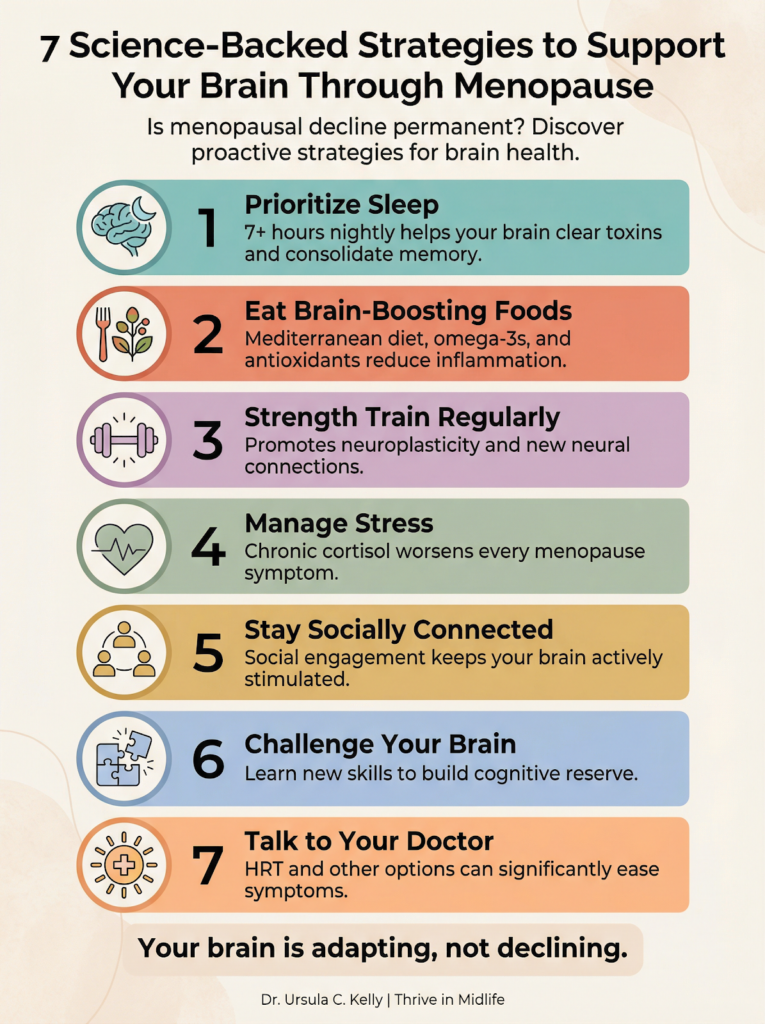
Step one is sleep—the foundation of everything. Without adequate, restorative sleep, every other intervention is less effective. Step two is nutrition: a Mediterranean-style diet rich in omega-3s, antioxidants, and whole foods provides the building blocks your brain needs to adapt and recover during the menopausal transition. Step three is strength training, which is perhaps the most underutilized tool in the menopausal wellness toolkit. The neuroplastic benefits of resistance exercise are profound, and they directly address the fear that is menopause decline permanent by building new neural connections.
Step four is stress management, which protects your hormonal balance and prevents the cortisol spiral that amplifies every symptom. Step five is social connection—one of the three major pillars for maintaining intact memory, alongside physical and cognitive activity [9]. Step six is challenging your brain with new learning: a new language, a musical instrument, a creative pursuit. This builds cognitive reserve that protects you against future decline. Step seven is having an honest conversation with your doctor about all available options, including hormone therapy, to ensure you’re making informed decisions rather than suffering unnecessarily.
Secret #7: You Don’t Have to Navigate Perimenopause and Menopause Alone
Perhaps the most powerful secret of all is this: the women who thrive through the menopausal transition are rarely the ones who white-knuckle it in isolation. They’re the ones who find their people—women who understand exactly what they’re going through, who can laugh about the 3 a.m. wake-ups and cry about the brain fog without judgment. Community is not a nice-to-have; it’s a genuine health intervention. And it’s one of the most powerful antidotes to the fear that is menopause decline permanent.
Finding a community of women who understand exactly what you’re going through can be incredibly validating. It reminds you that you aren’t broken and that your experiences are real and shared. Whether it’s discussing the nuances of perimenopause and menopause with a trusted friend, joining an online community, or enrolling in a structured program, connection is a vital part of the healing process. Research consistently shows that social support buffers the impact of stress on the body—and during a period of significant hormonal upheaval, that buffer can make an enormous difference in how you experience perimenopause and menopause.
The question “is menopause decline permanent” often comes from a place of profound isolation. When you feel like you’re the only one struggling, the fear amplifies. When you realize that millions of women are navigating the same transition—and that most of them come out the other side feeling better than they have in years—the fear begins to dissolve. You’re not alone in this, and you don’t have to figure it out by yourself. The answer to “is menopause decline permanent” is not just a scientific fact—it’s a lived reality for women who have come through this transition and emerged stronger, more confident, and more themselves than ever before.
The University of Melbourne’s 20-year study gives us a beautiful picture of what awaits on the other side [6]. Women who had been through the turbulent years of perimenopause and menopause reported feeling more patient, less tense, more financially secure, and more free to be themselves. They were actively engaging in their communities, pursuing their interests, and embracing the aging process with genuine acceptance and even joy. This is the destination. This is what’s possible when you stop asking “is menopause decline permanent” and start asking “how do I get to the other side?”
Further Reading & Trusted Sources
- Menopause Impacts Human Brain Structure — But Brain Biomarkers Recover Post-Menopause https://pmc.ncbi.nlm.nih.gov/articles/PMC8190071/
- Perimenopause as a Neurological Transition State https://pmc.ncbi.nlm.nih.gov/articles/PMC9934205/
- Menopause Stages, Duration, and What to Expect https://my.clevelandclinic.org/health/diseases/21841-menopause
- Menopause and Memory: Know the Facts https://www.health.harvard.edu/blog/menopause-and-memory-know-the-facts-202111032630
- Women Report Feeling Pretty Fantastic After Menopause https://www.futurity.org/women-aging-mood-1525342-2/
Conclusion: Your Most Powerful Chapter Is Still Ahead
I want you to take a deep breath and let this sink in: the answer to “is menopause decline permanent” is a resounding, science-backed no. You are not losing your mind, and your best years are not behind you. The symptoms you’re experiencing—the brain fog, the fatigue, the mood swings, the hot flashes—are the growing pains of a profound neurological and physical transition. Your brain is adapting, rewiring, and preparing for a new phase of life. Is menopause decline permanent? Absolutely not.
The symptoms of menopause are real, and they deserve to be taken seriously. But they are not your destiny. Understanding how long does menopause last gives you a timeline to work with rather than an endless horizon of suffering. Recognizing the transition to menopause when it begins gives you the power to act early and strategically. And navigating perimenopause and menopause with the right support—scientific, practical, and communal—transforms this transition from something that happens to you into something you actively shape.
Research consistently shows that women in their postmenopausal years often report feeling happier, more confident, and more in tune with themselves than ever before [6]. The women in that 20-year University of Melbourne study weren’t just surviving menopause—they were thriving in ways they hadn’t expected. More patient. Less tense. More free. That is what awaits you on the other side of this transition. Is menopause decline permanent? No. Is your most vibrant chapter still ahead? Yes.
If you’re ready to take actionable steps to clear the brain fog, reclaim your energy, and stop wondering whether menopause decline is permanent, I invite you to join my FREE 5-Day Menopause Brain Reset Course. Together, we’ll implement science-backed strategies to help you thrive in midlife and beyond. Join thousands of women who are already transforming their experience of perimenopause and menopause. You deserve to feel like yourself again—only better.
Frequently Asked Questions
What are the top 3 vitamins for menopause?
Vitamin D
Vitamin E
Vitamin B6
How many divorces are caused by menopause?
There is no specific percentage or exact number of divorces caused solely by menopause. However, studies suggest that relationship stress during menopause can contribute to marital issues, with some estimates indicating a possible increase in divorce rates during this life stage.
What mental illness is associated with menopause?
Menopause is often associated with anxiety and depression.
Is menopause for life?
Menopause is not for life, but it marks the end of menstruation and fertility, typically occurring in middle age. After menopause, women may experience postmenopause, which can last for years, but the symptoms and changes vary individually.
References
[4] Cleveland Clinic, “Menopause: What It Is, Age, Stages, Signs & Side Effects,” Jun. 24, 2024.
[8] J. M. Goldstein, “Menopause and memory: Know the facts,” Harvard Health Blog, Nov. 3, 2021.
[10] National Institute on Aging, “What Is Menopause?,” Oct. 16, 2024.