

Table of Contents
The Permission You’ve Been Waiting For
Let’s be honest for a moment. When was the last time you did something just for you — not for your partner, your kids, your aging parents, or your boss — but purely, unapologetically for yourself? If you’re drawing a blank, you’re not alone. For so many women navigating the menopause transition, their own needs have been on the back burner for so long they’ve practically evaporated.
It’s crucial for women to understand the importance of putting yourself first during menopause in order to maintain overall well-being.
You’ve become an expert juggler. You manage careers, coordinate family logistics, support adult children who still need you, and care for aging parents who need you even more. You’re the reliable one, the glue, the one who holds it all together. The one person who consistently falls off your priority list is the one staring back at you in the mirror.
As you navigate through this time, remember that putting yourself first during menopause serves not only you but also the loved ones around you.
This isn’t just an oversight. It’s a deeply ingrained pattern of self-neglect that menopause can amplify in devastating ways. And here’s what the research is showing us: putting yourself first during menopause isn’t a luxury or an act of selfishness. It’s a biological necessity — and arguably the most important thing you can do for your health, your relationships, and your quality of life right now [3].
Physical activity is a powerful tool in putting yourself first during menopause; it helps to manage symptoms effectively.
If you’re exhausted, running on empty, and carrying a quiet but relentless guilt about even wanting to rest, this article is for you. We’re going to look at the science behind why you feel this way, why it’s making your symptoms worse, and exactly what you can do to change it. Seven proven strategies. Real science. And the permission you’ve been waiting for.
The Hidden Cost of Putting Yourself Last During Menopause
You might think that pushing through, giving more, and keeping everyone else happy is just what good women do. But the research tells a very different story. The pattern of self-neglect that so many midlife women fall into doesn’t just feel bad — it actively worsens the physical and emotional symptoms of menopause [6].
In every aspect of life, putting yourself first during menopause is crucial for achieving balance.
Think about it this way: you wouldn’t run a car on an empty tank and expect it to perform well. Yet that’s exactly what you’re asking your body to do every single day. And during menopause, when your hormonal landscape is shifting dramatically, the cost of running on empty is even higher.
Remember, putting yourself first during menopause is essential for breaking the cycle of stress and self-neglect.
A 2025 study found that women who spend more hours caregiving experience significantly worse menopause symptoms — more severe hot flashes, greater sleep disruption, and more intense mood disturbances [6]. This isn’t a coincidence. Chronic stress and self-neglect keep your cortisol levels persistently elevated, which in turn amplifies every symptom you’re already struggling with. The guilt you feel about taking time for yourself is, quite literally, making you feel worse.
Understanding the Guilt-Cortisol-Symptom Cycle
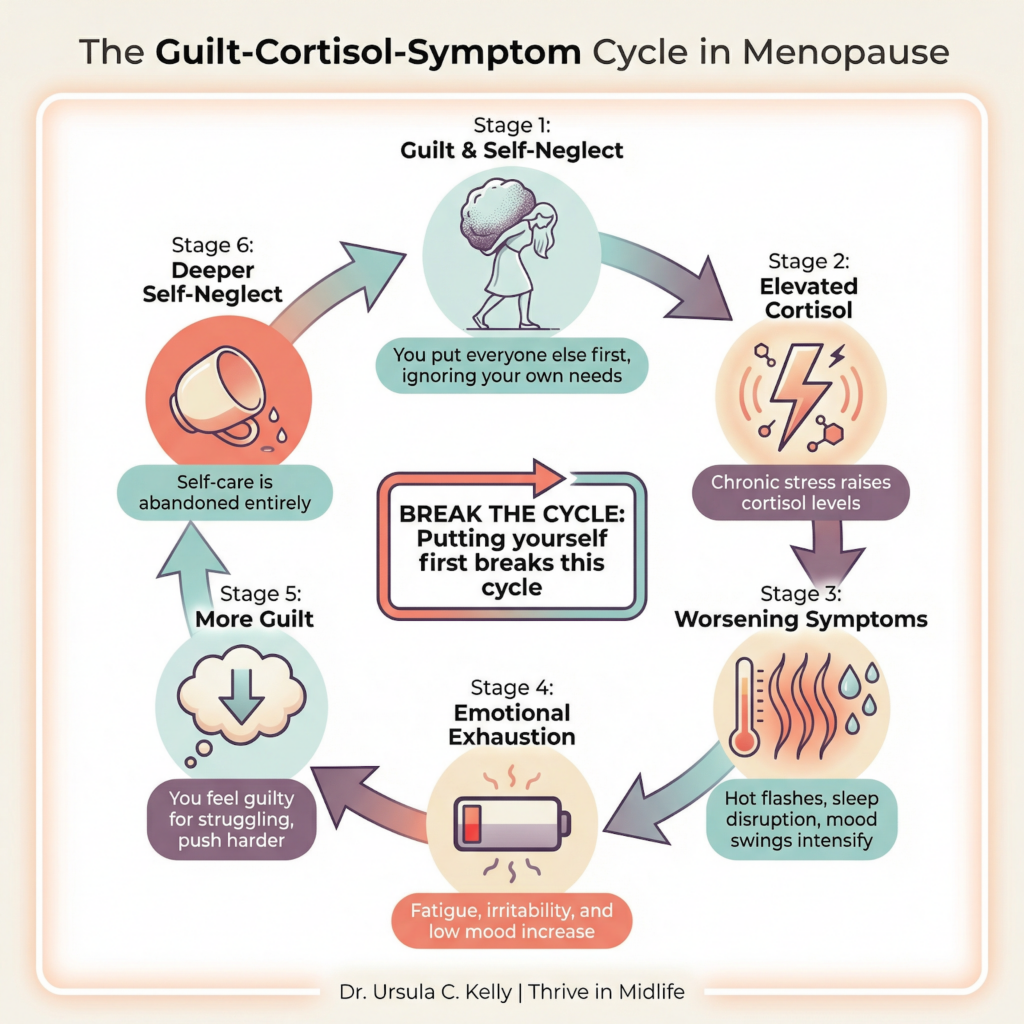
There’s a cycle that many women in menopause fall into without even realising it. It starts with guilt — that pervasive sense that your needs don’t matter as much as everyone else’s. Guilt keeps you in a state of chronic stress, which elevates cortisol. Elevated cortisol worsens menopause symptoms: your hot flashes intensify, your sleep deteriorates, your mood becomes more volatile. Feeling worse makes you feel guilty for struggling, so you push harder, neglect yourself more deeply, and the cycle continues. Putting yourself first during menopause is the intervention that breaks this cycle. It’s not indulgent. It’s strategic.
Mood Changes and Menopause: What’s Really Happening in Your Brain
One of the most distressing — and least talked about — aspects of menopause is the emotional upheaval. The irritability that comes from nowhere. The anxiety that wakes you at 3 a.m. The tears that arrive without warning. The guilt that follows every emotional moment. Understanding mood changes and menopause from a biological perspective is one of the most liberating things you can do for yourself.
Estrogen, Serotonin, and Your Emotional World
Your brain is exquisitely sensitive to hormonal changes. Estrogen doesn’t just regulate your reproductive system — it plays a critical role in modulating neurotransmitters, including serotonin, the brain’s primary mood-regulating chemical [1]. When estrogen levels fluctuate and decline during perimenopause and menopause, serotonin function is disrupted. This is why women are two to three times more likely than men to experience depression during hormonal transitions [1].
As Johns Hopkins Medicine explains, when estrogen and progesterone levels drop, serotonin levels also fall, contributing to increased irritability, nervousness, and anxiety [4]. This isn’t a character flaw. It isn’t weakness. It is a neurobiological reality that deserves compassion, not criticism.
The American College of Obstetricians and Gynecologists (ACOG) reports that approximately 4 in 10 women experience mood symptoms during perimenopause that are similar to premenstrual syndrome [2]. These symptoms can include irritability, low energy, tearfulness, and difficulty concentrating — and unlike PMS, they can occur at any time, with no predictable pattern. This unpredictability is particularly distressing for women who pride themselves on being in control.
The Guilt-Mood Loop: Why Blaming Yourself Makes Everything Worse
When you don’t understand that your mood changes are biologically driven, you blame yourself for them. You snap at your husband and spend the next two days consumed by guilt. You cry in the car on the way to work and tell yourself you’re falling apart. You feel anxious about nothing and convince yourself something must be wrong with you.
This self-blame is not just emotionally painful — it’s physiologically damaging. Chronic negative self-talk and self-criticism activate the stress response, raising cortisol and creating a feedback loop that worsens the very symptoms you’re struggling with [7]. Research confirms that women who experience higher levels of guilt and shame related to menopause report significantly lower quality of life [5].
Mood management is another area where putting yourself first during menopause can lead to significant improvements.
Understanding that your mood changes are a symptom — not a sign of weakness — is the first step toward loving yourself in menopause. You wouldn’t blame yourself for a hot flash. Your emotional symptoms deserve the same compassion.
How to Love Yourself in Menopause: 7 Proven Strategies
Now let’s get practical. Putting yourself first during menopause isn’t about grand, expensive gestures or radical life overhauls. It’s about small, consistent acts of self-compassion and self-care that, over time, fundamentally change how you feel. These seven strategies are grounded in research and designed for the realities of your life.
Strategy 1: Practise Radical Self-Compassion Daily
Self-compassion is not self-pity, and it’s not letting yourself off the hook. It’s treating yourself with the same kindness, understanding, and warmth you would offer a dear friend who was struggling. And the research on its impact is remarkable.
A landmark study published in Maturitas found that self-compassion was the strongest predictor of well-being in midlife women — more powerful than menopausal symptom severity, hormonal status, or any other factor measured [3]. Women who practised self-compassion found their symptoms less disruptive and reported significantly higher quality of life. A separate study from the University of Melbourne confirmed that women high in self-compassion experienced hot flashes just as frequently as other women — but the hot flashes interfered far less with their daily lives [8].
Self-compassion has three components: mindfulness (acknowledging your suffering without judgment), self-kindness (responding to yourself with warmth rather than criticism), and common humanity (recognising that suffering is a shared human experience, not a personal failing) [8]. You can begin practising right now. The next time you make a mistake or feel overwhelmed, place a hand gently over your heart and say, ‘This is hard. I’m doing my best. I deserve kindness.’
Ultimately, putting yourself first during menopause allows you to set the tone for your health and happiness.
Strategy 2: Set Boundaries Without Apologising
Boundaries are not walls. They are the loving limits that protect your energy and preserve your capacity to show up for the people you love. Every ‘yes’ you give to something that drains you is a ‘no’ to your own well-being. And during menopause, when your energy reserves are already compromised, unprotected boundaries are a serious health risk.
Start small. Identify one obligation this week that you can release or reduce. It might be a committee you’ve outgrown, a social commitment that exhausts rather than restores you, or a habit of saying ‘yes’ before you’ve even checked in with yourself. You don’t owe anyone a lengthy explanation. ‘I’m not able to commit to that right now’ is a complete and dignified sentence.
The act of setting a boundary is, in itself, an act of putting yourself first during menopause. It sends a powerful message to your nervous system: your needs matter.
Strategy 3: Schedule Non-Negotiable ‘You’ Time
If it’s not in the calendar, it won’t happen. This is not a criticism — it’s simply the reality of a busy life. Stop waiting for a pocket of free time to magically appear and start claiming it deliberately.
Block out a minimum of 20 minutes every single day that is non-negotiable ‘you’ time. This isn’t time to catch up on emails or run errands. This is time for something that genuinely restores you — reading, walking, journaling, meditating, sitting in silence with a cup of tea, or whatever fills your cup. Treat this appointment with the same seriousness you would a medical appointment, because in a very real sense, it is one.
The APA notes that practices like meditation, yoga, and journaling are among the most evidence-supported strategies for managing the emotional challenges of menopause [12]. These aren’t luxuries. They’re medicine.
By putting yourself first during menopause, you prioritize your emotional and physical well-being.
Strategy 4: Understand and Honour Your Mood Changes
As we’ve established, mood changes and menopause are biologically connected. When you understand this, you can begin to respond to your emotional experiences with curiosity rather than judgment. Instead of ‘What is wrong with me?’ try asking, ‘What does my body need right now?’
It’s time to embrace the joy of putting yourself first during menopause, allowing yourself to flourish.
Keep a simple mood journal for two weeks. Note the time of day, what you were doing, and how you felt. You may start to notice patterns — perhaps your anxiety peaks in the late afternoon, or your irritability spikes when you’ve slept poorly. This information is powerful. It allows you to anticipate and prepare rather than be blindsided and ashamed.
When a wave of emotion arrives, practise the ‘STOP’ technique: Stop what you’re doing, Take a breath, Observe what you’re feeling without judgment, and Proceed with kindness toward yourself. This simple mindfulness practice can interrupt the automatic guilt response and create space for a more compassionate reaction [12].
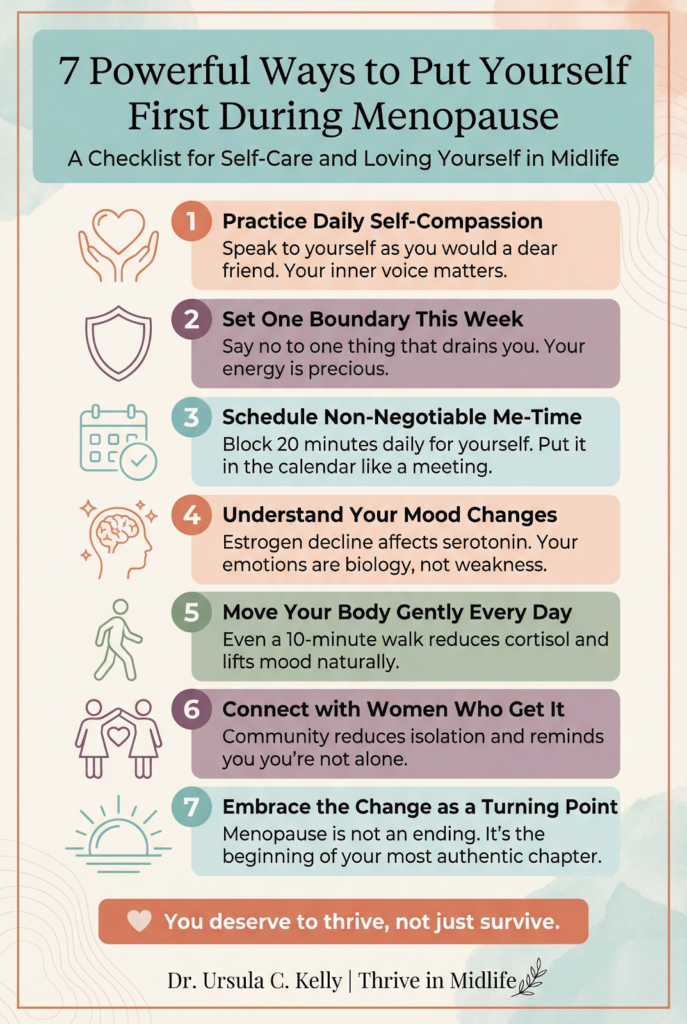
[ALT TEXT: A vertical infographic titled ‘7 Powerful Ways to Put Yourself First During Menopause,’ listing seven actionable self-care steps with icons: Practice Daily Self-Compassion, Set One Boundary This Week, Schedule Non-Negotiable Me-Time, Understand Your Mood Changes, Move Your Body Gently Every Day, Connect with Women Who Get It, and Embrace the Change as a Turning Point. Branding: Dr. Ursula C. Kelly | Thrive in Midlife.]
Putting yourself first during menopause is a journey worth taking for every woman.
Strategy 5: Move Your Body with Joy, Not Punishment
Exercise is one of the most potent natural interventions for menopause symptoms. It reduces cortisol, boosts endorphins, improves sleep quality, supports cognitive function, and helps with mood regulation [12]. But the way you approach movement matters enormously.
If your relationship with exercise is rooted in punishing your body for weight gain or forcing it to perform, you’re adding stress rather than relieving it. The goal during menopause is to find movement that feels genuinely good — that you look forward to, not dread. This might be a morning walk in nature, a gentle yoga class, dancing in your kitchen, swimming, or cycling. The ‘best’ exercise is the one you’ll actually do.
Remember that putting yourself first during menopause allows for deeper self-love and acceptance.
Aim for 20-30 minutes of enjoyable movement most days. Even a 10-minute walk has been shown to meaningfully reduce cortisol and improve mood [12]. This is not about achieving a certain body shape. This is about caring for the body that carries you through your life.
Strategy 6: Build Your Community
Putting yourself first during menopause encourages holistic healing and personal growth.
Menopause can feel profoundly isolating. You may feel like no one around you truly understands what you’re experiencing — not your partner, not your friends who sailed through without symptoms, not your doctor who has five minutes for you. This isolation compounds every other challenge.
Engaging in self-reflection is essential for putting yourself first during menopause and can lead to clarity.
Choose to empower yourself through putting yourself first during menopause, as it’s a vital act of self-care.
Prioritizing your needs through putting yourself first during menopause is an empowering choice.
Finding your community — women who get it — is one of the most powerful things you can do for your well-being. Research on self-compassion highlights ‘common humanity’ as one of its most potent components: the recognition that suffering is shared, that you are not uniquely broken, that others are walking this same path [8]. When you connect with other women in menopause, this recognition becomes visceral and healing.
Embracing the change also means putting yourself first during menopause, allowing you to see the opportunities it brings.
Seek out a support group, an online community, or even just one or two friends who are willing to talk honestly about what they’re experiencing. The Thrive in Midlife community is a wonderful place to start — a space where women support each other through every aspect of this transition, with warmth, humour, and zero judgment.

Strategy 7: Embrace the Change as a Turning Point
Our culture has a deeply unhelpful narrative about menopause. It frames it as a loss — the end of youth, fertility, and relevance. But this narrative is not only inaccurate; it’s actively harmful. When you internalise the idea that menopause is a decline, you approach it with grief and resistance, which amplifies your suffering [10].
What if you chose a different story? What if you chose to embrace the change as one of the most significant turning points of your life? Many cultures around the world view menopause very differently. In Japanese culture, the concept of ‘konenki’ frames this life stage as a time of renewal and increased vitality. In Chinese medicine, it’s sometimes called the ‘Second Spring.’ These aren’t just poetic metaphors — they reflect a fundamentally different relationship with this transition, one that research suggests leads to fewer and less severe symptoms [9].
Embracing the change doesn’t mean pretending everything is easy. It means choosing to see the gifts alongside the challenges. The freedom from monthly cycles. The clarity about what truly matters. The permission — finally — to put yourself first. The opportunity to discover who you are when you’re no longer defined primarily by your role as caregiver.
The women who thrive in and after menopause are not the ones who had the easiest symptoms. They’re the ones who chose to see this transition as an invitation to live more authentically, more boldly, and more fully on their own terms.
The Science of Self-Care: Why Your Body Needs You to Choose Yourself
Make a commitment to putting yourself first during menopause to experience the full range of life’s joys.
We’ve talked about the emotional and psychological case for putting yourself first during menopause. But the physiological evidence is equally compelling. Self-care isn’t just good for your soul — it’s good for your biology.
When you engage in genuinely restorative activities — whether that’s a warm bath, a walk in nature, a meditation practice, or simply sitting quietly with a book — your body releases oxytocin, often called the ‘bonding’ or ‘calm and connect’ hormone [11]. Oxytocin counteracts the effects of cortisol, reduces anxiety, lowers blood pressure, and promotes a sense of safety and well-being [11]. It’s your body’s natural antidote to the stress response.
Self-care education programmes have been shown to significantly improve quality of life in menopausal women, reducing symptom severity and improving psychological well-being [7]. This isn’t about spa days and bubble baths (though those are lovely). It’s about consistently choosing activities that signal to your nervous system: You are safe. You are cared for. You can rest.
The Lancet has called for greater attention to mental health during the menopause transition, noting that the risk of mood disorders increases significantly during this period and that proactive support strategies are both effective and necessary [10]. Choosing yourself isn’t just a nice idea. It’s a clinically supported health strategy.
Overcoming the Biggest Barrier: The Guilt
Every day presents an opportunity for putting yourself first during menopause, reminding you of your strength.
We’ve covered a lot of ground, but there’s one obstacle that deserves its own moment of attention: guilt. For many women, the greatest barrier to putting yourself first during menopause isn’t time or money or knowledge. It’s the deep, persistent belief that their needs don’t matter as much as everyone else’s.
Sharing your journey is a significant aspect of putting yourself first during menopause, fostering connections.
This belief is often so old and so ingrained that it feels like truth. But it isn’t. It’s a story — one that was written for you by a culture that has long expected women to give endlessly without replenishment. And it’s a story you have the power to rewrite.
Here’s a reframe that many women find transformative: you cannot pour from an empty cup. When you are depleted, exhausted, and resentful, you are not showing up as your best self for anyone. Your children, your partner, your aging parents — they don’t get the best of you when you’ve given everything away. They get the exhausted, frayed, short-tempered version. When you choose to replenish yourself, you become more present, more patient, more joyful, and more capable of genuine love and care.
Putting yourself first during menopause can lead to a renewed sense of purpose and passion.
Ensure you are prioritizing rest as part of putting yourself first during menopause to rejuvenate your body and mind.
Putting yourself first during menopause is not a betrayal of the people you love. It’s the most loving thing you can do for them.
Conclusion: Your Permission Slip to Choose Yourself
You’ve spent a lifetime giving. You’ve been reliable, capable, and endlessly present for everyone who needed you. Now, in the midst of one of the most significant biological transitions of your life, you are being asked to do something radical: to turn that same care and compassion inward.
Putting yourself first during menopause is not selfish. It’s not indulgent. It’s not something you need to earn or justify. It is a biological necessity, a psychological imperative, and — perhaps most importantly — something you simply deserve.
The seven strategies we’ve explored today — self-compassion, boundaries, scheduled self-time, understanding your mood changes, joyful movement, community, and embracing the change — are not complicated. They don’t require a lot of money or a lot of time. They require only one thing: the decision to begin.
Start today. Choose one strategy. Take one small step. And when the guilt shows up — because it will — meet it with the same compassion you’re learning to offer yourself. Say, ‘I see you, guilt. And I’m choosing myself anyway.’
You are not broken. You are not too much. You are not too late. You are a woman in the middle of a profound transformation, and you deserve every ounce of care, support, and love that you’ve been giving to everyone else.
Ready to Take the Next Step?
If you’re ready to take the next step, I warmly invite you to join our FREE 5-Day Menopause Brain Reset Course — a science-backed, supportive programme designed to help you clear the fog, calm the anxiety, and start feeling like yourself again. Thousands of women just like you have found their footing through this programme. You don’t have to navigate this alone. Because you deserve to thrive in this next chapter. Not just survive it.
How long does menopause typically last?
Menopause typically lasts about 4 to 5 years, but symptoms can vary widely and may last longer for some women.
What are the symptoms of low estrogen levels in menopause?
Symptoms of low estrogen levels in menopause include:
Hot flashes
Night sweats
Irregular periods
Vaginal dryness
Mood swings
Sleep disturbances
Decreased libido
Fatigue
Difficulty concentrating
Dry skin and hair
What are the best natural estrogen substitutes?
Soy Isoflavones
Red Clover
Black Cohosh
Flaxseed
Dong Quai
Maca Root
Wild Yam
Chaste Tree Berry (Vitex)
Ashwagandha
Evening Primrose Oil
Who should not use hormone replacement therapy?
Individuals with a history of hormone-sensitive cancers, unexplained vaginal bleeding, active liver disease, severe arterial disease, or those who have had a heart attack or stroke should not use hormone replacement therapy.
Go Deeper: Trusted Resources to Empower Your Menopause Journey
1. The Menopause Society — Mental Health During Menopause
URL:https://menopause.org/patient-education/menopause-topics/mental-health
2. SWAN Study — Better Psychological Well-Being Through Menopause
URL:https://www.swanstudy.org/womens-health-info/better-psychological-well-being-through-menopause/
3. ADAA — Menopause and Mental Health: Understanding the Connection and Recommendations for Treatment
URL:https://adaa.org/learn-from-us/from-the-experts/blog-posts/consumer/menopause-and-mental-health
4. NIH/PMC — Oxytocin and Women’s Health in Midlife
URL:https://pmc.ncbi.nlm.nih.gov/articles/PMC11404667/
5. The Guardian — “Can You Prepare for a Good Menopause? Perhaps Start by Thinking of It as a ‘Second Spring'”
References
[1] K. M. Albert and P. A. Newhouse, “Estrogen, stress, and depression: Cognitive and biological interactions,” Annu. Rev. Clin. Psychol., vol. 15, pp. 399–423, Feb. 20, 2019. doi: https://doi.org/10.1146/annurev-clinpsy-050718-095557
[2] American College of Obstetricians and Gynecologists, “Mood changes during perimenopause are real. Here’s what to know,” ACOG, Apr. 2023, reviewed Feb. 2025. [Online]. Available: https://www.acog.org/womens-health/experts-and-stories/the-latest/mood-changes-during-perimenopause-are-real-heres-what-to-know
[3] L. Brown, J. Bryant, V. Brown, B. Bei, and J. Judd, “Investigating how menopausal factors and self-compassion shape well-being: An exploratory path analysis,” Maturitas, vol. 81, no. 3, pp. 377–382, Jul. 2015. doi: https://doi.org/10.1016/j.maturitas.2015.04.006
[4] Johns Hopkins Medicine, “Perimenopause and anxiety,” Johns Hopkins Medicine. [Online]. Available: https://www.hopkinsmedicine.org/health/wellness-and-prevention/perimenopause-and-anxiety
[5] P. Zivdir, “Effect of feelings of guilt and shame on life quality of menopausal women,” Med. Sci., vol. 6, no. 1, pp. 7–12, Mar. 2017. doi: https://doi.org/10.5455/medscience.2016.05.8508
[6] News-Medical.net, “Longer caregiving hours tied to worse menopause symptoms in women,” Jan. 30, 2025. [Online]. Available: https://www.news-medical.net/news/20250130/Longer-caregiving-hours-tied-to-worse-menopause-symptoms-in-women.aspx
[7] M. Taebi, S. Abdolahian, F. Ozgoli, A. Ebadi, and N. Kariman, “Strategies to improve menopausal quality of life: A systematic review,” J. Educ. Health Promot., vol. 7, p. 93, Jun. 2018. doi: https://doi.org/10.4103/jehp.jehp_137_17
[8] L. Brown, “Self-compassion may help women cope with menopausal symptoms,” Pursuit, University of Melbourne, Jun. 29, 2017. [Online]. Available: https://pursuit.unimelb.edu.au/articles/self-compassion-may-help-women-cope-with-menopausal-symptoms
[9] Mayo Clinic, “Perimenopause — symptoms and causes,” Mayo Clinic. [Online]. Available: https://www.mayoclinic.org/diseases-conditions/perimenopause/symptoms-causes/syc-20354666
[10] “Promoting good mental health over the menopause transition,” The Lancet, vol. 402, no. 10416, pp. 1967–1968, Nov. 2023. doi: https://doi.org/10.1016/S0140-6736(23)02801-5
[11] K. Uvnäs-Moberg, L. Handlin, and M. Petersson, “Self-soothing behaviors with particular reference to oxytocin release induced by non-noxious sensory stimulation,” Front. Psychol., vol. 5, p. 1529, Jan. 12, 2015. doi: https://doi.org/10.3389/fpsyg.2014.01529
[12] American Psychological Association, “Menopause can be rough. Psychology is here to help,” APA Monitor on Psychology, Sep. 1, 2023. [Online]. Available: https://www.apa.org/monitor/2023/09/easing-transition-into-menopause