

Table of Contents
It starts so quietly, doesn’t it? A little more distance on the couch. A conversation that feels like you’re speaking two different languages. A touch that feels more like a habit than a connection. You look at the person you’ve built a life with and wonder, “Who are you? And who have I become?” If this sounds familiar, you’re not alone, and you’re not going crazy. The truth is, you might be experiencing the profound and often devastating impact of menopause affecting marriage.
This isn’t just a few hot flashes or bad nights. It’s a seismic shift that can shake the very foundation of your partnership — leaving you feeling misunderstood, your partner confused, and a growing silence where intimacy once lived. Millions of women are navigating this right now, often without the language or support to do it well. The good news? This transition doesn’t have to end your story. If you’re ready to reclaim your relationship, our FREE 5-Day Menopause Brain Reset Course is a powerful place to start.
How Menopause and Intimacy in Marriage Are Deeply Connected
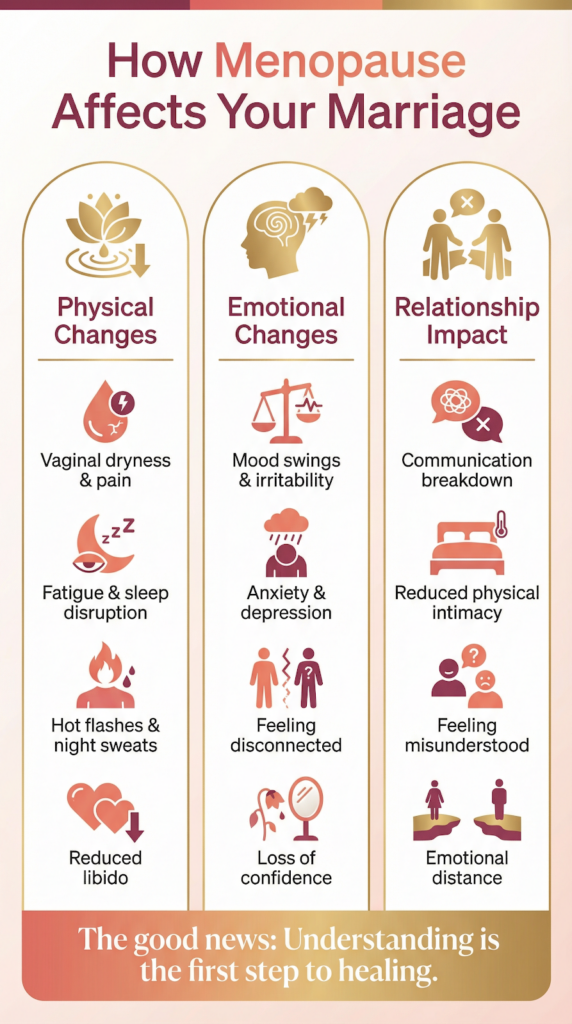
One of the most immediate and distressing ways you might feel menopause affecting marriage is in the bedroom. What was once a source of connection and pleasure can become a landscape of anxiety and pain. This isn’t a personal failing; it’s a direct result of significant biological changes.
The Hormonal Cascade That Changes Everything
During perimenopause and menopause, your estrogen levels don’t just decline; they fluctuate wildly before they drop. Estrogen is a key player in your sexual health. It helps maintain the elasticity, thickness, and lubrication of your vaginal tissues. As estrogen wanes, these tissues can become thinner, drier, and less flexible. This condition, known as Genitourinary Syndrome of Menopause (GSM), can make intercourse uncomfortable or even painful (dyspareunia) [1].
But it’s not just physical. These hormonal shifts also impact your libido. Testosterone, another hormone that plays a role in female desire, also declines during this time. When you combine physical discomfort with a dip in natural desire, it’s no wonder that menopause and intimacy in marriage becomes a major source of strain. A groundbreaking study published in the Journal of Mid-Life Health found that a staggering 91.3% of menopausal women experience some form of sexual dysfunction [2]. It’s a silent epidemic that can leave you feeling broken and your partner feeling rejected.
Genitourinary Syndrome: The Intimacy Thief Nobody Talks About
GSM is one of the most under-discussed yet widespread consequences of menopause. Beyond painful sex, its symptoms can include vaginal dryness, burning, itching, and increased urinary urgency or infections [3]. These persistent, uncomfortable symptoms can make you want to avoid intimacy altogether. You’re not “making excuses”; you’re trying to avoid real, physical pain.
Many women are too embarrassed to discuss these symptoms with their partners or even their doctors. They suffer in silence, which only widens the emotional gap. Your partner may misinterpret your avoidance of sex as a rejection of them personally, leading to a painful cycle of hurt feelings and misunderstanding. The good news is that GSM is highly treatable. From over-the-counter moisturizers and lubricants to prescription vaginal estrogen therapies, there are many effective solutions available [4]. Acknowledging the physical reality of GSM is the first step toward reclaiming menopause and intimacy in marriage.
Menopause Mood Swings Marriage: Why You’re Not “Going Crazy”
Do you ever feel like you’re on an emotional rollercoaster you can’t get off? One minute you’re fine, and the next you’re snapping at your husband over something trivial, only to be flooded with guilt moments later. These intense emotional shifts are a hallmark of menopause mood swings marriage problems, and they are rooted in your brain chemistry.
The Estrogen-Serotonin Connection
Estrogen plays a crucial role in regulating neurotransmitters in your brain, particularly serotonin, the “feel-good” chemical that helps stabilize your mood [5]. When estrogen levels are erratic, so is your serotonin production. This can lead to increased irritability, anxiety, sadness, and even fits of rage that feel completely out of character. Research has confirmed that perimenopause is a period of high risk for developing depression and anxiety, with some studies showing that up to 70% of women experience significant irritability during this time [6].
These aren’t just “bad moods.” They are neurobiological events. You’re not choosing to be angry or weepy. Your brain is struggling to adapt to a new hormonal reality. Understanding this can be incredibly validating. It’s not a flaw in your character; it’s a symptom of a physiological process. This is a critical distinction to make when menopause is affecting your marriage.
When Your Partner Doesn’t Understand Your Emotional Volatility
For your partner, living with these mood swings can be like walking on eggshells. They may feel confused, hurt, and defensive, unable to understand why the woman they love seems to have been replaced by an angry, unpredictable stranger. This is where the danger of perimenopause ruining my marriage becomes very real.
Your partner may withdraw to protect themselves, or they may become critical, which only makes you feel more isolated and misunderstood. They don’t see the internal battle you’re fighting; they only see the external emotional storm. This is why open menopause relationship communication is not just helpful—it’s essential for survival.

Is Perimenopause Ruining My Marriage? Warning Signs to Watch For
It often starts with a feeling of unease, a sense that the ground beneath your feet is shifting. If you’re worried that perimenopause is ruining my marriage, you’re tuning into real warning signs that the connection is fraying. Recognizing these patterns is the first step to changing them.
The Dangerous Silence Pattern
Does this sound familiar? You’re feeling anxious and irritable, and sex is the last thing on your mind. Your partner, feeling rejected and confused, stops initiating. You’re relieved to not have the pressure, so you don’t bring it up. He interprets your silence as confirmation that you’re no longer interested in him. The silence grows, and with it, the distance. This is the dangerous silence pattern, and it’s a breeding ground for resentment and misunderstanding. Each partner tells themselves a story about the other’s behavior, and those stories are almost always wrong.
When Distance Becomes the Default
Another warning sign is when emotional and physical distance becomes your new normal. You stop sharing the small details of your day. You retreat to separate corners of the house in the evening. “How was your day?” is met with a one-word answer. This isn’t just a phase; it’s a coping mechanism that can become a permanent state. The less you connect, the less you want to connect, and the cycle reinforces itself. This emotional estrangement is a significant factor in why menopause is affecting marriage so deeply.
Menopause and Divorce in Midlife: Understanding the “Menodivorce” Trend
The unfortunate reality is that for many couples, the strain of menopause proves to be too much. The term “gray divorce” refers to the rising trend of divorce among couples over 50, and there’s a growing recognition of the role menopause plays in this phenomenon, sometimes called a “menodivorce.”
Why Divorce Rates Rise During Menopause
Research and surveys paint a stark picture. One UK-based survey found that 7 out of 10 women blamed menopause for the breakdown of their marriage [7]. The combination of physical changes, emotional volatility, and communication breakdown creates a perfect storm. The same study that found low marital adjustment in 74.1% of menopausal women also highlighted that menopause negatively impacts the sexual adjustment of both spouses, showing that the husband is also deeply affected [2]. When both partners are struggling and lack the tools to navigate the crisis, the relationship itself can become the casualty.
What Separates Couples Who Thrive from Those Who Don’t
But here’s the hopeful truth: menopause and divorce in midlife is not an inevitability. The couples who successfully navigate this transition are not the ones who don’t have problems. They are the ones who learn to communicate about them. They treat menopause not as a “woman’s issue,” but as a “couple’s challenge” that they must face together. They replace blame with curiosity and silence with vulnerability.
Menopause Relationship Communication: Practical Strategies That Actually Work
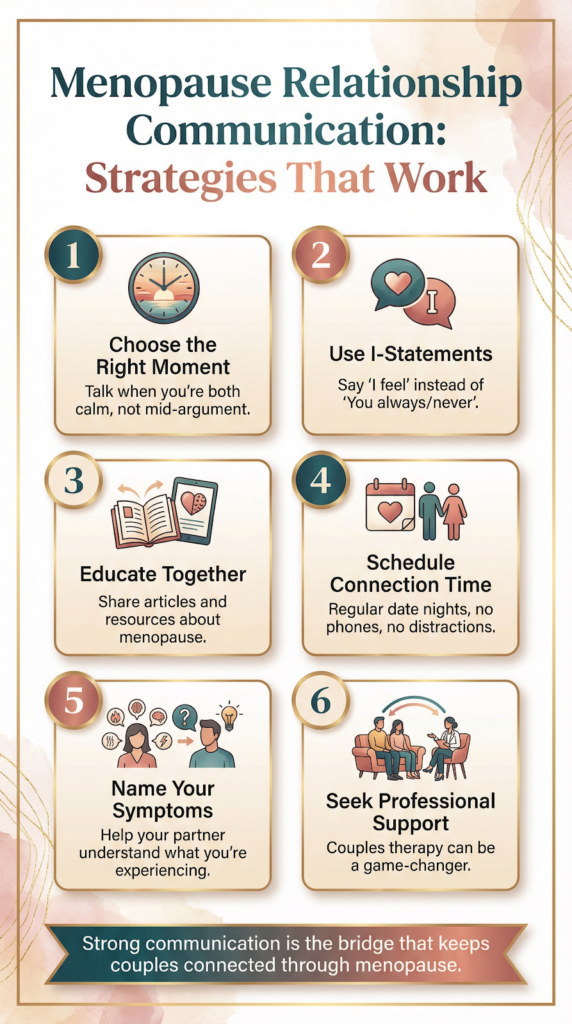
If you feel like menopause is affecting your marriage, focusing on communication is the single most powerful thing you can do. It’s the bridge that will carry you from a place of disconnection to a new, more resilient partnership.
How to Talk to Your Partner About What You’re Experiencing
Starting the conversation is often the hardest part. Choose a calm moment, not the middle of a fight. Use “I” statements to avoid blame. Instead of saying, “You don’t touch me anymore,” try, “I feel lonely and disconnected from you, and I miss our physical closeness.”
Share resources with him. Send him an article (like this one!) or a link to an expert site like The Menopause Society or the NHS website [8, 9]. Explain the biological changes. Help him understand that your mood swings aren’t a reflection of your love for him, but a symptom of fluctuating hormones. This isn’t about making excuses; it’s about providing context.
Building a New Kind of Intimacy
Menopause and intimacy in marriage may need to be redefined for a season. If intercourse is painful, focus on other forms of physical touch: cuddling on the couch, holding hands, giving each other massages. The goal is to maintain physical connection and affection, which is the foundation of sexual intimacy. As you address the physical symptoms of GSM, you can slowly and gently rediscover sexual intimacy together, with open communication and without pressure [10].
When to Seek Professional Help
Sometimes, the patterns of miscommunication and hurt are too deeply entrenched to solve on your own. There is immense strength in seeking professional help. A couples therapist can provide a safe space to have difficult conversations and teach you both new communication tools [11]. Seeing a therapist isn’t a sign of failure; it’s a sign that your relationship is worth fighting for.
Conclusion: Your Marriage Can Survive—and Even Thrive—Through Menopause
The journey of menopause affecting marriage is undeniably one of the most challenging a couple can face. It tests your patience, your empathy, and the very core of your connection. But it does not have to be a death sentence for your relationship. By understanding the profound physical and emotional changes at play, you can begin to replace blame with compassion and fear with understanding.
This is your opportunity to build a new kind of partnership—one forged in honesty, strengthened by vulnerability, and deepened by the shared experience of navigating a storm together. It’s a chance to talk more openly than ever before and to find a new, more authentic way of being intimate. Your best chapter doesn’t have to be behind you. It could be just beginning.
If you’re ready to take the next step and transform your journey through menopause, I invite you to join our community of women who are doing this work together. Our 90-Day Transformational Course provides the tools, support, and expert guidance to not just survive menopause, but to thrive through it—in your health, your life, and your relationships.
Frequently Asked Questions
Q1: Can menopause really affect my marriage? Absolutely, and you’re not imagining it. Menopause triggers significant hormonal shifts that can impact your mood, libido, sleep, and emotional resilience — all of which directly affect how you show up in your relationship. The good news is that understanding what’s happening biologically is the first step to navigating it together. Menopause doesn’t have to damage your marriage; with the right tools and communication, many couples find it actually deepens their connection.
Q2: Why do I feel so angry and irritable with my husband during perimenopause? This is one of the most common — and most distressing — experiences women report during perimenopause. Fluctuating estrogen levels directly affect serotonin, the brain chemical that regulates mood. When estrogen dips, so does your emotional buffer. The irritability, rage, and tearfulness you’re feeling aren’t a character flaw; they’re a neurobiological response to hormonal change. Letting your partner know this is happening — and why — can make a world of difference to how he responds.
Q3: How do I talk to my partner about menopause affecting our intimacy? Choose a calm, neutral moment — not the middle of a disagreement. Use “I” statements to express how you’re feeling without placing blame, such as “I’ve been struggling with physical discomfort that’s making intimacy difficult, and I miss feeling close to you.” Share reliable resources with him so he can understand the biology behind what you’re experiencing. Remember, this is a conversation you’re having together, not a confession. Vulnerability invites connection.
Q4: Is it normal for couples to divorce during menopause? Unfortunately, yes — research shows that divorce rates among couples over 50 have risen significantly in recent decades, a trend sometimes called “gray divorce.” Some surveys suggest that menopause plays a role in a significant number of these separations, often because couples lack the communication tools to navigate the transition. However, divorce is not inevitable. Couples who treat menopause as a shared challenge — rather than a personal failing — are far more likely to come through it stronger.
Q5: What can my husband do to support me through menopause? The single most powerful thing a partner can do is listen without trying to fix. Validate your experience rather than minimise it. Educate himself about what menopause actually involves — the hormonal shifts, the physical symptoms, the emotional volatility. Be patient with the changes in intimacy and avoid taking them personally. And if the strain on the relationship feels too great to navigate alone, suggest couples therapy together. Showing up with curiosity and compassion rather than frustration is the foundation of getting through this as a team.
Want to Learn More? Start Here
1. The Menopause Society — Sexual Health
URL:https://menopause.org/patient-education/menopause-topics/sexual-healthWhy it enhances the article: The North American Menopause Society (NAMS) is the gold-standard medical authority on menopause. This page covers the full spectrum of sexual health changes — libido, vaginal dryness, GSM, and treatment options — making it the perfect companion resource for the intimacy section. Suggested anchor text:“The Menopause Society’s guidance on sexual health”
2. American College of Obstetricians and Gynecologists (ACOG) — Mood Changes During Perimenopause
URL:https://www.acog.org/womens-health/experts-and-stories/the-latest/mood-changes-during-perimenopause-are-real-heres-what-to-knowWhy it enhances the article: ACOG is one of the most credible OB-GYN authorities in the world. This article validates that mood changes during perimenopause are real and affect approximately 4 in 10 women — directly supporting the mood swings and marriage section. Suggested anchor text:“ACOG confirms that mood changes during perimenopause are real”
3. Mayo Clinic — Women’s Sexual Health: Talking About Your Sexual Needs
URL:https://www.mayoclinic.org/healthy-lifestyle/sexual-health/in-depth/womens-sexual-health/art-20047771Why it enhances the article: Mayo Clinic is universally trusted by readers. This page specifically addresses how to talk to your partner about sexual needs — a direct, practical complement to the communication strategies section. Suggested anchor text:“Mayo Clinic’s advice on talking to your partner about sexual needs”
4. Psychology Today — 10 Tips for Couples Navigating Menopause
URL:https://www.psychologytoday.com/us/blog/the-aftermath-of-trauma/202404/10-tips-for-couples-navigating-menopauseWhy it enhances the article: Written by a licensed clinician, this Psychology Today piece provides evidence-based, practical relationship strategies. It reinforces the communication and couples therapy sections with professional psychological authority. Suggested anchor text:“expert-backed tips for couples navigating menopause”
5. NHS Inform — Sexual Wellbeing, Intimacy and Menopause
URL:https://www.nhsinform.scot/healthy-living/womens-health/later-years-around-50-years-and-over/menopause-and-post-menopause-health/sexual-wellbeing-intimacy-and-menopause/Why it enhances the article: The NHS is one of the most trusted healthcare institutions globally. This page directly addresses the myth that menopause ends your sex life and provides practical, compassionate guidance — perfectly aligned with the article’s hopeful, empowering tone. Suggested anchor text:“NHS guidance on sexual wellbeing and intimacy during menopause”
References
[1] “Genitourinary Syndrome of Menopause (GSM),” The North American Menopause Society. [Online]. Available: https://www.menopause.org/for-women/sexual-health-menopause-online/changes-at-midlife/genitourinary-syndrome-of-menopause-(gsm)
[2] F. Yildirim, N. B. Duman, and O. Kulakaç, “The Effect of Menopause on the Sexual Functions and Marital Adjustment of the Spouses,” Journal of Mid-Life Health, vol. 14, no. 3, pp. 170–175, 2023. [Online]. Available: https://pmc.ncbi.nlm.nih.gov/articles/PMC10836430/
[3] “Vaginal Atrophy,” Cleveland Clinic. [Online]. Available: https://my.clevelandclinic.org/health/diseases/15500-vaginal-atrophy
[4] “Sex After Menopause,” Johns Hopkins Medicine. [Online]. Available: https://www.hopkinsmedicine.org/health/expert-qa/how-sex-changes-after-menopause
[5] W. Wharton, C. E. Gleason, and S. O. Olson, “Neurobiological underpinnings of the estrogen–mood relationship,” Current Psychiatry Reviews, vol. 8, no. 3, pp. 247–256, 2012. [Online]. Available: https://pmc.ncbi.nlm.nih.gov/articles/PMC3753111/
[6] “Menopause and Anger: Why Am I So Mad at My Partner?,” Medical Specialists of the Twin Cities. [Online]. Available: https://www.medicalspecialistsmn.com/post/menopause-and-anger
[7] “Menopause puts final nail in marriage coffin,” balance-menopause.com. [Online]. Available: https://www.balance-menopause.com/news/menopause-puts-final-nail-in-marriage-coffin/
[8] “Sexual Health,” The Menopause Society. [Online]. Available: https://menopause.org/patient-education/menopause-topics/sexual-health
[9] “Sexual wellbeing, intimacy and menopause,” NHS inform. [Online]. Available: https://www.nhsinform.scot/healthy-living/womens-health/later-years-around-50-years-and-over/menopause-and-post-menopause-health/sexual-wellbeing-intimacy-and-menopause/
[10] “Menopause and sexuality,” Office on Women’s Health. [Online]. Available: https://womenshealth.gov/menopause/menopause-and-sexuality
[11] L. J. Solomon and A. M. Tein, “10 Tips for Couples Navigating Menopause,” Psychology Today, Apr. 29, 2024. [Online]. Available: https://www.psychologytoday.com/us/blog/the-aftermath-of-trauma/202404/10-tips-for-couples-navigating-menopause